




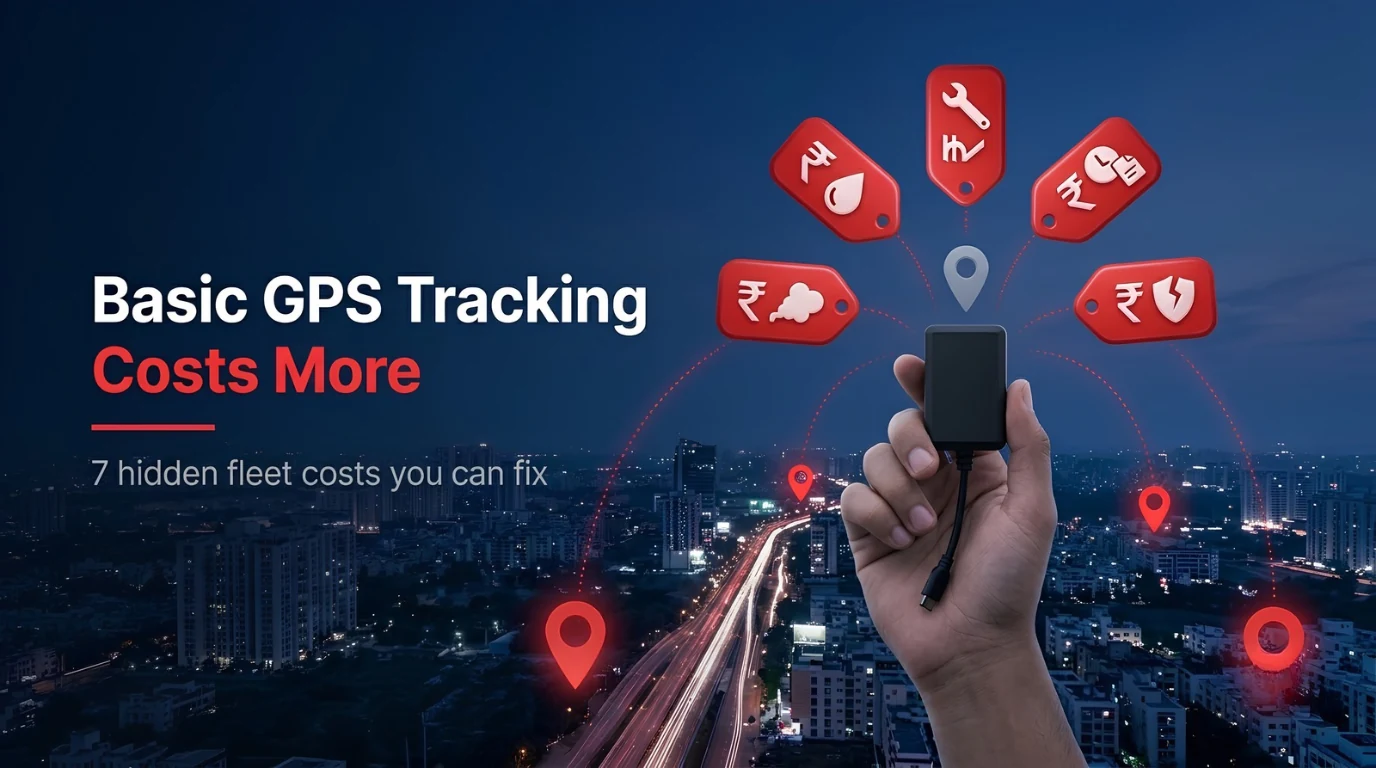
Companies spend more with basic GPS tracking because it only shows where vehicles are, not why they cost so much to run. Without data on idling, driving behaviour, engine health, and how each vehicle is used, fuel waste, avoidable breakdowns, accidents, and hours of manual reporting stay hidden. An advanced fleet tracking system, often called telematics, turns that hidden spending into alerts and reports managers can act on.
The cheapest tracker is rarely the cheapest option. Fuel is the largest single cost in road freight in India, at 42.1% according to an NCAER study for the Department for Promotion of Industry and Internal Trade, so even small inefficiencies that a basic tracker cannot see add up quickly across a fleet.
This guide explains the seven hidden costs of basic GPS tracking, how advanced fleet tracking reduces them, how to work out what basic tracking is really costing you, and what to look for when you upgrade.
What this guide covers
- Basic GPS tracking vs. advanced fleet tracking
- 7 hidden costs of basic GPS tracking
- How advanced fleet tracking cuts costs
- How to calculate what basic tracking costs you
- Signs your fleet has outgrown basic tracking
- What to look for when you upgrade
- FAQs
Basic GPS Tracking vs. Advanced Fleet Tracking
Both use a GPS device in the vehicle. The difference is how much data they collect and what they do with it.
- Location updates: basic trackers often report every few minutes. Advanced systems report every few seconds while the vehicle is moving and store data when there is no signal.
- Trip history: basic systems show a line on a map. Advanced systems add stops, idle time, speed, and arrival times at each site.
- Driver behaviour: basic systems record little or nothing. Advanced systems score speeding, harsh braking, harsh acceleration, and sharp cornering, and can add AI cameras that warn tired or distracted drivers.
- Vehicle health: basic trackers cannot read the engine. Advanced devices read engine fault codes, battery voltage, and engine hours, and set service reminders based on actual use.
- Fuel: basic systems can only estimate fuel from distance. Advanced systems measure idling and can use fuel level sensors to spot sudden drops that point to theft.
- Alerts and reports: basic systems leave managers to read the map themselves. Advanced systems send alerts for problems and build automatic reports.
- Integration: basic systems are a standalone website. Advanced systems have APIs that send data to ERP, payroll, dispatch, and maintenance software.
7 Hidden Costs of Basic GPS Tracking
1. Fuel Lost to Idling
An idling engine burns fuel without moving the load. Argonne National Laboratory estimates that an idling heavy-duty truck uses about 0.8 US gallons (around 3 litres) of fuel an hour, and the US Department of Energy puts a car at roughly 1–2 litres an hour. A basic tracker shows a vehicle standing still, but not that its engine has been running for an hour, so the waste goes unnoticed.
2. Aggressive Driving and Speeding
The US Department of Energy estimates that aggressive driving, such as speeding, rapid acceleration, and hard braking, can lower fuel economy by roughly 15–30% at highway speeds and 10–40% in stop-and-go traffic. It also wears out brakes and tyres faster and raises the risk of accidents. Without driver behaviour data, managers cannot see which drivers need coaching.
3. Breakdowns That Could Have Been Prevented
A basic tracker cannot read engine fault codes or warn that a battery is weakening. Small faults go unnoticed until the vehicle breaks down on a route, which adds towing, emergency repairs, a missed delivery, and a vehicle off the road. Maintenance based on guesswork also means some vehicles are serviced too often and others too late.
4. Hours of Manual Reporting
When a system only shows dots on a map, someone has to turn that into timesheets, mileage claims, customer reports, and fuel reconciliations by hand. Those hours are a real cost, and the reports are often late and incomplete.
5. Unauthorised Use and Fuel Theft
Private trips, after-hours use, and fuel siphoning are hard to prove with location data alone. Advanced systems add after-hours and geofence alerts, ignition reports, and fuel level sensors that flag sudden drops in the tank.
6. Idle Vehicles and Wasted Capacity
Without utilisation reports, it is hard to see which vehicles sit unused for days. Businesses then buy or lease extra vehicles when they could move work to the ones they already have.
7. Accidents, Claims, and Disputes
When an accident or customer complaint happens, a basic tracker may only show where the vehicle was. Advanced systems add speed, harsh events, and camera footage, which help settle disputes, reject false claims, and coach drivers before an accident happens.
How Advanced Fleet Tracking Cuts Costs
Each hidden cost has a matching feature in an advanced system:
- Idling alerts and reports show which vehicles and drivers waste the most fuel standing still.
- Driver behaviour scores and coaching reduce speeding, harsh driving, and fuel use, and AI cameras add real-time warnings for fatigue and distraction.
- Engine diagnostics and maintenance reminders catch faults early and schedule services by actual distance or engine hours.
- Automatic reports replace manual timesheets, mileage logs, and customer delivery records.
- Geofences, after-hours alerts, and fuel sensors flag unauthorised use and fuel theft as it happens.
- Utilisation reports show where vehicles sit idle, so work can be moved before new vehicles are bought.
- Trip replay, harsh-event data, and video provide evidence for accidents, claims, and customer disputes.
How to Calculate What Basic Tracking Costs You
You do not need a full study to estimate the hidden cost. Work through these five steps using your own records:
- Idling cost: estimate the average idle hours per vehicle each day, multiply by the litres used per hour and your fuel price, then by working days and vehicles.
- Driving behaviour cost: take your annual fuel bill and apply a conservative saving, such as 5%, that driver coaching could achieve.
- Breakdown cost: add up the towing, emergency repairs, and lost jobs from roadside breakdowns in the last year.
- Admin cost: multiply the hours spent each week on manual reports by the hourly cost of the staff who prepare them.
- Compare: add the totals and compare them with the extra annual cost of an advanced system. ROI (%) = (annual savings − annual system cost) ÷ annual system cost × 100.
Example: a fleet of 20 delivery vans that each idle for 1 hour a day, using 1.5 litres an hour at ₹95 a litre over 300 working days, spends about ₹8.5 lakh a year on idling alone. Halving that idle time saves more than ₹4 lakh a year before any other savings are counted. Use your own fuel prices and idle hours for an accurate figure.
Signs Your Fleet Has Outgrown Basic GPS Tracking
- Fuel costs keep rising, but you cannot tell which vehicles or drivers are responsible.
- Vehicles break down on routes without any earlier warning.
- Managers spend hours each week building reports from tracking data.
- You find out about speeding or unsafe driving only after a complaint or accident.
- You suspect fuel theft or private use but cannot prove it.
- Customers ask for live arrival times or proof of delivery you cannot easily provide.
- Your trackers still run on 2G or 3G networks that are being switched off in many countries.
What to Look for When You Upgrade
- Fast, reliable data: location updates every few seconds while moving, and offline storage when there is no signal.
- 4G devices: 4G LTE or LTE-M trackers, not 2G or 3G hardware that may soon stop working.
- Driver behaviour and cameras: scoring for harsh driving, with AI dashcams where safety matters most.
- Engine diagnostics: devices that read fault codes and engine data, such as plug-in OBD-II trackers.
- Fuel monitoring: idle reports, and fuel level sensors for vehicles at risk of theft.
- Useful alerts and reports: customisable alerts and scheduled reports, so the system does the analysis for you.
- Integrations: an open API to connect with payroll, dispatch, ERP, and maintenance software.
- Clear pricing: compare the total cost over three years, and start with a pilot on a few vehicles to measure real savings.
How Anstel Connected Fleet Helps
Anstel Connected Fleet, part of the Autonautics platform, goes beyond basic location tracking. It combines 4G tracking devices with live tracking that refreshes every few seconds, geofences, driving behaviour monitoring, AI cameras, fuel management, maintenance reminders, and reports and analytics on web and mobile. Plug-in OBD-II 4G trackers install in minutes and read engine data, wired 4G trackers suit trucks and buses, and APIs connect fleet data to other business systems.
Frequently Asked Questions
What is the difference between basic GPS tracking and telematics?
Basic GPS tracking shows where a vehicle is and where it has been. Telematics, or advanced fleet tracking, adds data on driving behaviour, idling, fuel, engine health, and alerts, and turns it into reports, so managers can see why vehicles cost what they do and act on it.
Why does basic GPS tracking cost companies more?
Basic tracking hides the biggest fleet costs: fuel lost to idling and aggressive driving, preventable breakdowns, unauthorised use and fuel theft, under-used vehicles, and hours of manual reporting. Because these costs are not measured, they are not reduced.
How much fuel does idling waste?
According to Argonne National Laboratory, an idling heavy-duty truck uses about 0.8 US gallons, or around 3 litres, of fuel an hour. The US Department of Energy estimates that a car uses roughly 1–2 litres an hour, depending on engine size and air conditioning.
Is advanced fleet tracking worth the extra cost?
For most fleets, yes. Savings on idling, fuel, breakdowns, and admin time usually outweigh the higher subscription. The best way to check is a short pilot: record your costs for three months before and after, and compare them with the system's price.
Can I upgrade without replacing all my trackers?
Often, yes. Many platforms support devices from several manufacturers, so you can add advanced features to newer vehicles first and replace older 2G or 3G trackers as they need it.
What features should I look for in a fleet tracking system?
Look for location updates every few seconds, 4G devices, driver behaviour scoring, engine diagnostics, idle and fuel monitoring, customisable alerts and reports, an open API, and clear pricing over three years.
Stop Paying for What You Cannot See
Basic GPS tracking answers one question: where is the vehicle? The costs that matter most, such as idling, driving habits, breakdowns, and wasted hours, stay hidden until a fleet measures them. Upgrading to advanced fleet tracking makes those costs visible, so they can finally be reduced.
Get in touch with the Anstel team to plan a pilot and see what basic tracking is costing your fleet.