










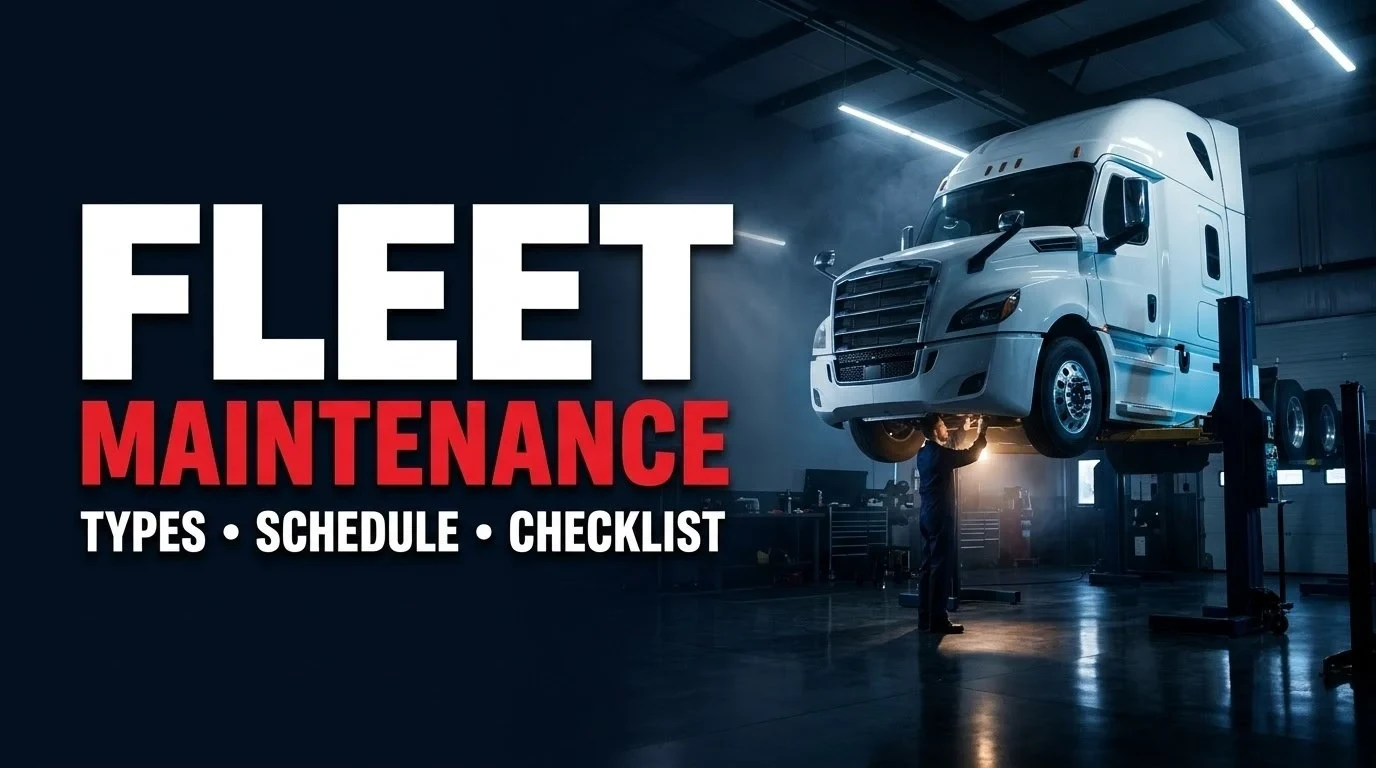
Fleet maintenance is the work of keeping a company's vehicles safe, legal, and ready for the road. It covers routine servicing, inspections, repairs, and the records that go with them. A well-run fleet maintenance program means fewer breakdowns, lower repair and fuel bills, and vehicles that last longer.
This guide explains the four types of fleet maintenance, how to set a service schedule, what to put on your checklist, which numbers to track, and how telematics and fleet maintenance software make the whole job easier.
What this guide covers
- What is fleet maintenance?
- Why fleet maintenance matters
- Types of fleet maintenance
- How to create a maintenance schedule
- Fleet maintenance checklist
- How to build a maintenance program
- Who is responsible for fleet maintenance
- Fleet maintenance KPIs
- How to reduce maintenance costs
- Fleet maintenance software and telematics
- Maintenance and compliance in India
- FAQs
What Is Fleet Maintenance?
Fleet maintenance is everything a business does to keep its vehicles and mobile equipment in good working order, from drivers' daily checks to engine overhauls. It applies to any fleet: delivery vans, trucks, buses, company cars, two-wheelers, and construction or farm equipment.
A fleet maintenance program usually includes:
- Scheduled servicing, such as oil and filter changes, brake checks, and tyre rotation, based on distance, engine hours, or time.
- Inspections, from drivers' daily walkaround checks to detailed workshop inspections.
- Repairs of faults found during inspections or reported by drivers.
- Compliance work, such as fitness certificates, emission tests, and insurance renewals.
- Records of every job, including the date, odometer reading, parts, cost, and time off the road.
Fleet maintenance vs. fleet management
Fleet management is the wider job of running a fleet: buying vehicles, planning routes, managing drivers, fuel, and costs. Fleet maintenance is one part of it, focused on the condition of the vehicles. The two are closely linked, because the same vehicle tracking system that shows where a vehicle is can also tell you when it is due for service.
Why Fleet Maintenance Matters
Skipping maintenance rarely saves money. It moves the cost to a worse moment, usually a breakdown in the middle of a job. A structured program pays off in several ways:
- Safer vehicles: worn brakes, bald tyres, and faulty lights contribute to crashes. In the US Federal Motor Carrier Safety Administration's Large Truck Crash Causation Study, brake problems were the most frequently recorded vehicle factor, noted for 29% of the large trucks involved in serious crashes.
- More uptime: a vehicle in the workshop for planned service is off the road for hours. A vehicle that breaks down can be off the road for days, along with the load it was carrying.
- Lower repair costs: replacing brake pads on time costs far less than replacing pads, discs, and calipers after the pads have worn through. Small faults caught early stay small.
- Better fuel efficiency: under-inflated tyres, clogged air filters, and dragging brakes make the engine work harder and burn more fuel.
- Fewer compliance problems: complete service records make fitness tests, audits, and insurance claims much simpler.
- Higher resale value: a vehicle with a full service history sells for more.
- Happier customers: reliable vehicles mean on-time deliveries and fewer cancelled jobs.
Types of Fleet Maintenance
There are four main types of fleet maintenance. Most fleets use a mix of them, with the aim of doing as much planned work and as little emergency repair as possible.
1. Reactive maintenance
Reactive, or corrective, maintenance means repairing a vehicle after it fails. Some reactive work is unavoidable, such as punctures and accident damage. When most of a fleet's maintenance is reactive, it usually means preventive work is being missed.
- When it happens: after something fails.
- Example: fixing a puncture, a broken mirror, or accident damage.
- Best for: unavoidable failures only. It is the most costly approach.
2. Preventive maintenance
Preventive maintenance (PM) is planned work done at regular intervals, whether or not anything seems wrong. Intervals come from the manufacturer's service schedule and are usually set by distance, by engine hours for equipment and vehicles that idle a lot, or by calendar time for parts that age even when a vehicle is parked, such as batteries, coolant, and brake fluid.
- When it happens: at fixed intervals of distance, engine hours, or time.
- Example: an oil and filter change at the interval in the manufacturer's manual.
- Best for: every fleet. It is the foundation of any program.
3. Condition-based maintenance
Condition-based maintenance waits until an inspection or sensor reading shows that a part needs work. It avoids replacing parts that still have life left, but it depends on regular, accurate checks.
- When it happens: when an inspection or sensor reading shows a part needs attention.
- Example: replacing tyres when the tread reaches its wear limit.
- Best for: wear parts such as tyres, brakes, and batteries.
4. Predictive maintenance
Predictive maintenance uses data from the vehicle, such as engine fault codes, coolant and oil temperature, battery voltage, and driving patterns, to spot problems before they cause a breakdown. It needs a telematics device that reads engine data and software that flags unusual trends.
- When it happens: before a likely failure, based on trends in vehicle data.
- Example: replacing a battery whose starting voltage has been falling for weeks.
- Best for: fleets with telematics that reads engine data.
How to Create a Fleet Maintenance Schedule
A maintenance schedule sets out which checks and services each vehicle needs, and when. Build it from the manufacturer's service schedule, then adjust it for how each vehicle is actually used. Here is a typical structure:
Every day, before the first trip (driver)
Tyres for damage or obvious under-inflation, lights and indicators, brakes, mirrors, horn, wipers, leaks under the vehicle, and dashboard warning lights.
Every week (driver or supervisor)
Tyre pressures with a gauge; engine oil, coolant, brake fluid, and washer fluid levels; battery terminals; and the condition of the cab and load area.
Every month (supervisor or technician)
Tyre tread depth and wear pattern, belts and hoses, wiper blades, seat belts, and safety equipment such as the fire extinguisher and first-aid kit.
At each service interval: km, engine hours, or months (technician)
Engine oil and filter, air and fuel filters, brakes, steering and suspension, wheel alignment and tyre rotation, battery health, and any open fault codes.
Every year, or as the law requires (fleet manager)
A full inspection and renewal of the fitness certificate, emission certificate, insurance, and permits where they apply.
Shorten the intervals for vehicles on severe duty: heavy loads, stop-start city routes, dusty or unpaved roads, hilly terrain, and long idling. Most manufacturers publish a separate severe-duty schedule for exactly this reason.
Record the date and odometer reading of every service, so the next one is triggered automatically instead of relying on a sticker on the windscreen or someone's memory.
Fleet Maintenance Checklist
Adapt this checklist to your vehicle types and the manufacturer's recommendations. Give the same list to any outside workshop that services your fleet, so every vehicle is checked to the same standard.
- Engine and fluids: engine oil and filter, coolant, transmission fluid, brake fluid, power steering fluid, and any leaks.
- Filters: air, fuel, and cabin filters.
- Brakes: pads, shoes, discs, drums, brake lines, and the parking brake.
- Tyres and wheels: pressure, tread depth, sidewall damage, uneven wear, wheel nuts, alignment, and the spare tyre.
- Steering and suspension: play in the steering, shock absorbers, springs, bushes, and joints.
- Electrical system: battery charge and terminals, alternator, starter motor, lights, indicators, and horn.
- Belts and hoses: cracks, fraying, tension, and leaks.
- Exhaust and emissions: leaks, mountings, and emission certificate status.
- Body, glass, and mirrors: windscreen chips and cracks, mirrors, doors, locks, and load-area fittings.
- Safety equipment: seat belts, fire extinguisher, first-aid kit, warning triangle, and any emergency button fitted.
- Documents: registration, insurance, fitness certificate, emission certificate, and permits, with their expiry dates.
How to Build a Fleet Maintenance Program
A maintenance program turns the schedule and checklist into a routine that runs every week. These seven steps work for fleets of any size:
- List every asset. Record each vehicle's make, model, year, chassis number, current odometer reading or engine hours, warranty terms, and document expiry dates.
- Set service intervals. Start from the manufacturer's schedule, then shorten intervals for vehicles on severe duty.
- Train drivers on daily checks. Give them a short checklist and a simple way to report defects, ideally a mobile form that accepts photos.
- Decide who does the work. Choose between an in-house workshop, dealer service centres, or a network of local garages, and agree on prices and turnaround times.
- Automate reminders. Use odometer and engine-hour data from telematics to trigger services, instead of manual calendars.
- Keep complete records. Log the date, odometer reading, work done, parts, cost, and time off the road for every job.
- Review the numbers every month. Track the KPIs below, and adjust intervals, suppliers, or vehicles where costs or breakdowns are rising.
Who Is Responsible for Fleet Maintenance?
Fleet maintenance works best when three groups each know their part:
- Fleet manager: owns the maintenance plan and budget, schedules services, manages workshops and suppliers, keeps vehicles compliant, and decides when to replace ageing vehicles.
- Drivers: are the first line of defence. They carry out daily checks, report defects straight away, and drive in a way that limits wear on brakes, tyres, and engines.
- Technicians and mechanics: carry out inspections, servicing, and repairs, in-house or at an outside workshop, and record what they found and fixed.
Clear defect reporting connects all three. A driver who notices a soft brake pedal needs a quick way to report it, and the fleet manager needs to see the report and book the repair before the next trip.
Fleet Maintenance KPIs to Track
These numbers show whether your maintenance program is working. Track them for each vehicle and for the fleet as a whole.
- Vehicle availability (uptime): how much of the time vehicles are ready for work. Hours available ÷ total scheduled hours × 100
- Preventive maintenance compliance: how many services are done on time. Services completed on time ÷ services due × 100
- Planned vs. unplanned work: how much maintenance is scheduled rather than emergency. Planned jobs ÷ all maintenance jobs × 100
- Maintenance cost per km: what it costs to keep each vehicle running. Total maintenance cost ÷ kilometres driven
- Mean distance between failures: how far vehicles travel between breakdowns. Total kilometres ÷ number of breakdowns
- Average downtime per repair: how quickly vehicles return to service. Total repair downtime ÷ number of repairs
- Repeat repairs: whether faults are fixed properly the first time. Repairs for the same fault within 30 days ÷ all repairs × 100
A rising share of unplanned work, or a falling distance between failures, is usually the first sign that preventive maintenance is slipping.
How to Reduce Fleet Maintenance Costs
- Stick to the preventive schedule. Planned work is cheaper than emergency repairs, roadside recovery, and missed deliveries.
- Catch faults early. Engine fault code alerts from a telematics device flag problems before the driver notices them.
- Improve driving behaviour. Harsh braking, rapid acceleration, and speeding wear out brakes, tyres, and engines faster. Coaching drivers with data from a driver monitoring system reduces that wear.
- Cut idling. Long idling burns fuel and adds engine hours without moving the vehicle.
- Look after tyres. Check pressures every week, rotate tyres, and correct wheel alignment. Correctly inflated tyres last longer and use less fuel.
- Use your warranties. Check warranty and extended warranty cover before paying for a repair.
- Standardise your vehicles. Fewer makes and models mean fewer spare parts to stock and technicians who know the vehicles well.
- Replace vehicles at the right time. Track maintenance cost per km for each vehicle. When an ageing vehicle's running costs keep rising, replacing it can cost less than keeping it.
How Fleet Maintenance Software and Telematics Help
Spreadsheets and paper logbooks work for a handful of vehicles but break down as a fleet grows. Fleet maintenance software keeps every vehicle's schedule, history, and costs in one place, and telematics feeds it real data from the vehicles.
A telematics device fitted to the vehicle records distance travelled and engine hours. Devices connected to the vehicle's OBD-II diagnostic port can also read engine data such as diagnostic trouble codes (DTCs), coolant temperature, and engine load. The device sends this data over the mobile network to the software, which turns it into reminders, alerts, and reports.
Features to look for in fleet maintenance software
- Service reminders based on actual odometer readings and engine hours, not just dates
- Engine fault code alerts and vehicle health checks
- Digital inspection forms and defect reporting for drivers
- A full service history and cost record for each vehicle
- Reminders for document renewals such as insurance, fitness, and emission certificates
- Spare parts tracking
- Reports on maintenance costs, downtime, and the KPIs above
- An easy-to-use dashboard and a mobile app
- Integration with GPS tracking and fuel data, so you can see maintenance alongside how each vehicle is used
How Anstel Connected Fleet supports maintenance
Anstel Connected Fleet combines GPS vehicle tracking with maintenance tools, including service scheduling, predictive maintenance, spare parts tracking, and vehicle health checks. Its OBD-II plug-and-track device reads engine data such as fault codes, engine load, coolant temperature, and engine oil temperature, so you know which part needs attention before it turns into a breakdown.
Fleet Maintenance and Compliance in India
For commercial vehicles in India, maintenance and legal compliance go hand in hand:
- Fitness certificate: transport vehicles need a valid certificate of fitness. Under the Central Motor Vehicles Rules, a renewed fitness certificate is generally valid for two years for vehicles up to eight years old and for one year for older vehicles. Fitness testing is moving to Automated Testing Stations in phases, so check your state transport department for the current schedule.
- Pollution under control (PUC) certificate: every vehicle needs a valid PUC certificate, and a well-maintained engine is far more likely to pass the emission test.
- AIS 140 tracking: public service vehicles and goods vehicles with a national permit must have a working AIS 140 vehicle location tracking device and emergency button. Include both in your routine checks.
- Insurance, permits, and road tax: keep these renewal dates in the same system as your service reminders, so nothing expires unnoticed.
Other countries have their own rules. In the United States, for example, commercial motor vehicles must pass an annual inspection, and drivers must complete vehicle inspection reports. Check the regulations wherever your fleet operates.
Frequently Asked Questions
What is fleet maintenance?
Fleet maintenance is the work of keeping a company's vehicles safe, reliable, and legal to drive. It includes scheduled servicing, inspections, repairs, compliance tasks such as fitness and emission certificates, and keeping a record of all this work for every vehicle.
What are the four types of fleet maintenance?
The four types are reactive maintenance, which repairs a vehicle after it breaks down; preventive maintenance, done at set intervals; condition-based maintenance, done when an inspection or sensor reading shows a need; and predictive maintenance, which uses vehicle data to fix problems before they cause a failure.
What is the difference between preventive and predictive maintenance?
Preventive maintenance follows a fixed schedule based on distance, engine hours, or time. Predictive maintenance uses data from the vehicle, such as engine fault codes, temperatures, and battery voltage, to estimate when a part is likely to fail and service it just before then.
How often should fleet vehicles be serviced?
Follow the service intervals in each vehicle's manufacturer manual, which are usually set by distance, engine hours, or months, whichever comes first. Vehicles on severe duty, such as heavy loads, stop-start city driving, dusty roads, or long idling, usually need shorter intervals. Drivers should also do a quick check before every trip.
What should a fleet maintenance checklist include?
A fleet maintenance checklist should cover engine oil and other fluids, filters, brakes, tyres and wheels, steering and suspension, the electrical system and lights, belts and hoses, the exhaust, the body and glass, safety equipment, and the expiry dates of vehicle documents.
What does a fleet maintenance manager do?
A fleet maintenance manager plans and schedules servicing, manages workshops and parts suppliers, makes sure vehicles meet safety and legal requirements, controls the maintenance budget, keeps service records, and decides when vehicles should be repaired or replaced.
How does GPS tracking help with fleet maintenance?
A GPS tracking device records each vehicle's distance and engine hours, so services can be scheduled on actual use rather than guesswork. Devices connected to the vehicle's diagnostic port can also report engine fault codes and other engine data, giving early warning of problems before they cause a breakdown.
Keep Your Fleet on the Road
Good fleet maintenance comes down to a clear schedule, drivers who check and report, complete records, and a few numbers reviewed every month. Telematics makes each of these easier by triggering services on real usage and warning you about engine faults early.
Get in touch with the Anstel team to see automated service reminders and engine alerts working on your own vehicles.