




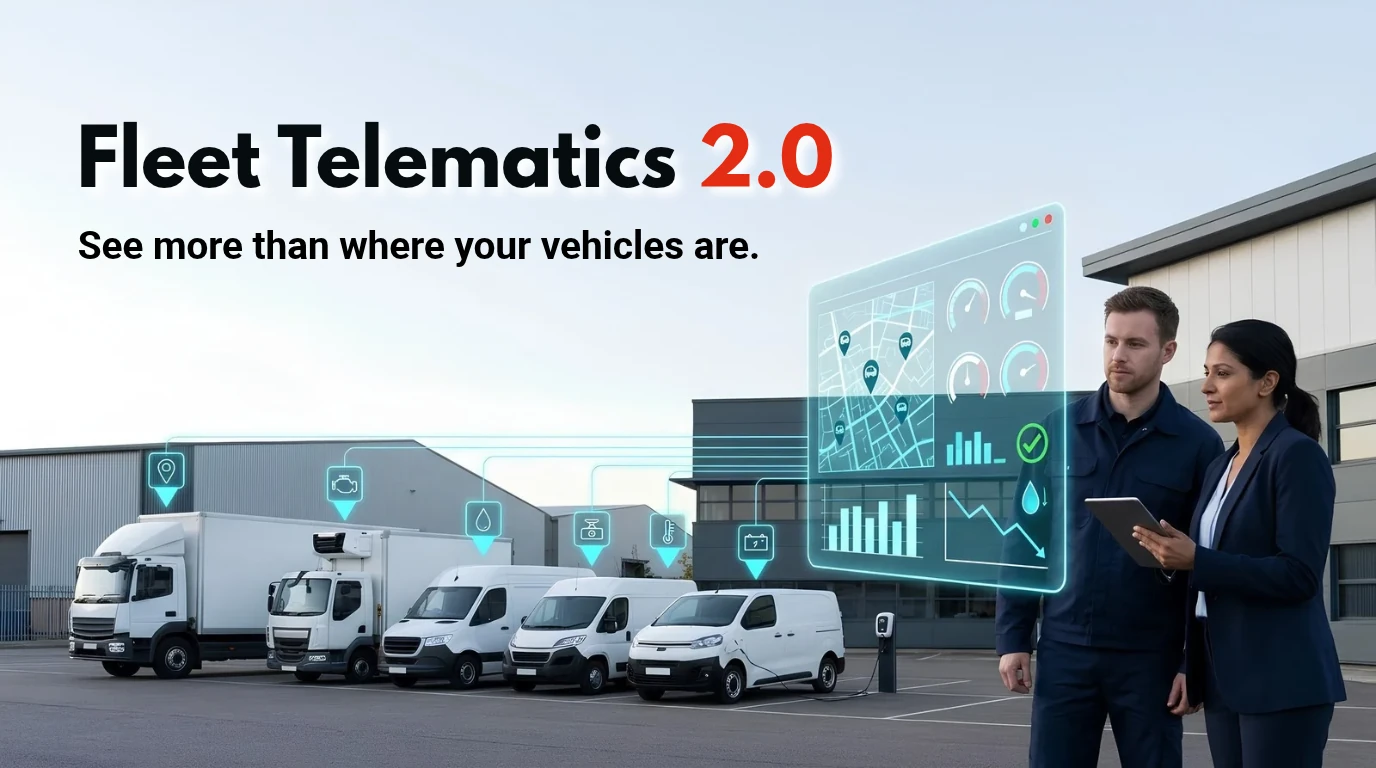
Fleet telematics combines tracking devices in vehicles, mobile connectivity, and software so businesses can see where every vehicle is, how it is being driven, and what condition it is in. Today it goes far beyond dots on a map: AI cameras, engine diagnostics, fuel data, and links to other business systems turn that information into lower costs, safer drivers, and easier compliance.
This guide explains how fleet telematics works, how it has changed from basic GPS tracking to what is often called Telematics 2.0, the features that matter most now, the compliance rules it helps with in India and other markets, what it costs, and how to work out your return on investment.
What this guide covers
- What is fleet telematics?
- How fleet telematics works
- From basic tracking to Telematics 2.0
- Latest telematics features to look for
- Compliance rules telematics helps with
- Cost benefits of telematics
- How much fleet telematics costs
- How to choose a provider
- FAQs
What Is Fleet Telematics?
The word telematics joins telecommunications and informatics. In a fleet, it means collecting data from each vehicle, sending it over a mobile network, and turning it into information managers can act on: live location, driving behaviour, engine health, fuel use, and more.
Fleet Management vs. Telematics
Fleet management is the job: buying vehicles, assigning drivers, planning routes, controlling fuel and maintenance costs, and keeping everything legal. Telematics is the technology that feeds that job with accurate, up-to-date data. A fleet can be managed without telematics, but every decision then relies on phone calls, logbooks, and guesswork.
How Fleet Telematics Works
Every telematics system has four layers that work together:
- Devices and sensors: a GPS tracker plugged into the OBD-II port or wired into the vehicle, plus optional cameras, fuel sensors, and temperature probes.
- Connectivity: a SIM card sends data over 4G networks, increasingly using low-power IoT technologies such as LTE Cat-M1, with 5G arriving for data-heavy uses such as video.
- Cloud platform: servers store the data, apply rules such as speed limits and geofences, and use analytics and AI to spot patterns.
- Dashboards, apps, and integrations: managers see live maps, alerts, and reports, while APIs send the data to ERP, transport management, maintenance, and payroll systems.
From Basic Tracking to Telematics 2.0
Early systems answered one question: where is the vehicle? Modern telematics, sometimes called Telematics 2.0, answers what is happening, why, and what to do next.
- Data collected: basic tracking records location, sometimes only every few minutes. Modern telematics records location every few seconds, plus speed, engine data, fuel, video, and sensor readings.
- Insight: basic tracking gives dots on a map and trip history. Modern telematics adds driver scores, fault predictions, and automatic alerts.
- Safety: basic tracking sends speeding reports after the event. Modern telematics uses AI cameras that warn drivers about drowsiness or phone use in real time.
- Maintenance: basic tracking relies on odometer readings entered by hand. Modern telematics reads engine fault codes and sets service reminders based on actual use.
- Connectivity: older devices run on 2G and 3G networks, which are being switched off in many countries. Modern devices use 4G LTE and LTE Cat-M1, with 5G for video and data-heavy uses.
- Integration: basic tracking is a standalone website. Modern telematics has open APIs linked to ERP, transport management, fuel cards, and insurance.
Latest Fleet Telematics Features to Look For
AI Video Telematics and Driver Monitoring
Road-facing and driver-facing cameras record events such as harsh braking and collisions, while an AI-powered driver monitoring system detects drowsiness, distraction, phone use, and missing seat belts and alerts the driver immediately. Video also protects the business: it shows what really happened in a crash and helps reject false claims. It is one of the most effective ways to tackle reckless driving.
Engine Diagnostics and Predictive Maintenance
Devices connected to the vehicle's diagnostic port read engine fault codes, coolant temperature, battery voltage, and engine hours. The platform turns these into alerts and service reminders based on actual use, so faults are fixed before they become breakdowns.
Fuel Monitoring and Theft Detection
Fuel is the single largest part of road freight costs in India, at 42.1%, according to an NCAER study for the Department for Promotion of Industry and Internal Trade. Telematics cuts fuel waste by flagging idling, speeding, harsh acceleration, and detours, and fuel level sensors can detect sudden drops that point to theft.
Smarter Routing and Accurate Arrival Times
Telematics does not plan routes on its own, but its data makes route planning far better. Trip history shows where vehicles lose time, live location lets dispatchers reassign jobs when plans change, and arrival times can be shared with customers automatically.
Over-the-Air Updates
Modern tracking devices receive firmware updates over the air (FOTA), so new features and security fixes reach every vehicle without a workshop visit. Many newer vehicles also receive their own software updates the same way.
Cargo and Cold Chain Sensors
Wireless sensors monitor temperature, humidity, and door openings in the cargo area, which matters for food, dairy, and pharmaceutical loads. The system raises an alert as soon as a reading leaves the safe range and keeps a temperature record for every trip.
Electric Vehicle Telematics
For electric fleets, telematics adds battery charge, remaining range, energy use, and charging status, so managers can plan routes and charging around each vehicle's real range.
Open Integrations and APIs
Telematics data is most valuable when it flows into the systems teams already use. Look for open APIs that connect to ERP, transport management, fuel card, maintenance, and payroll software.
Faster, Longer-Lasting Connectivity
Many countries are switching off older 2G and 3G networks. In Australia, Telstra and Optus began switching off their 3G networks on 28 October 2024, and the Australian Government warned that tracking devices relying on 3G could stop working. Choose devices that run on 4G LTE or LTE Cat-M1. 5G will matter most for video and for vehicle-to-everything (V2X) communication between vehicles, roads, and traffic systems.
Compliance Rules Fleet Telematics Helps With
Rules differ by country and vehicle type. These are the main ones that telematics data helps fleets meet:
- India · AIS 140 vehicle location tracking: public service vehicles and national permit goods vehicles need a certified tracking device and emergency button that report to state command centres.
- India · Digital Personal Data Protection Act, 2023 and DPDP Rules, 2025: driver location and behaviour data can be personal data, so fleets need clear notices, secure storage, and sensible retention periods.
- India · IRDAI telematics add-ons (2022): driving data supports Pay As You Drive and Pay How You Drive motor insurance add-ons.
- European Union · Smart tachograph version 2: required on heavy vehicles in international transport since August 2025, and on vans over 2.5 tonnes in international transport since 1 July 2026. It records border crossings and loading operations.
- United States · FMCSA electronic logging device (ELD) rule: most commercial drivers must record their hours of service electronically.
- Australia · 3G network closure (October 2024): tracking devices must run on 4G or newer networks to keep working.
In India, the DPDP Rules were notified in November 2025, with most duties for businesses taking effect after 18 months. Rules change often, so confirm current requirements with the relevant authority or a legal advisor.
Cost Benefits of Fleet Telematics
The savings come from several places at once. Measure each one before and after rollout to see the real return:
- Fuel: less idling, speeding, and detours, and fuel theft detected early. Measure: fuel cost per km.
- Maintenance: faults caught early and services based on actual use. Measure: maintenance cost per km and number of breakdowns.
- Insurance and claims: safer driving, driver scores, and video evidence. Measure: claims per year and premium at renewal.
- Vehicle use: idle vehicles spotted and moved to busier routes. Measure: trips or hours per vehicle per day.
- Safety: real-time alerts and coaching reduce crashes. Measure: harsh events per 100 km and accidents per year.
- Administration: automatic reports replace logbooks and phone calls. Measure: hours spent on manual tracking each week.
- Theft: after-hours and geofence alerts, and faster recovery. Measure: losses and recovery time.
How Much Does Fleet Telematics Cost?
Prices vary with the hardware, features, and fleet size, but the total cost always has the same parts:
- Hardware: a one-time cost per vehicle. Plug-in OBD-II trackers cost the least; hardwired, AIS 140 certified, and camera systems cost more.
- Installation: minimal for plug-in devices, higher for wired devices and cameras.
- Subscription: a monthly or annual fee per vehicle covering the data plan, software, and support.
- Add-ons: cameras, fuel and temperature sensors, and integrations with other systems.
Pricing models also differ. Some providers sell hardware upfront with a subscription, some rent the hardware as part of the plan, and some, including Anstel, offer pay-as-you-drive plans priced by distance. A plug-in OBD-II 4G device is a low-cost way to start.
How to Calculate Telematics ROI
- Measure a baseline. Record fuel cost per km, maintenance cost, breakdowns, idle hours, and accidents for three months before rollout.
- Measure again after rollout. Track the same numbers for the first three to six months.
- Add up the annual savings you can actually see in the data, not estimates.
- Work out the return. ROI (%) = (annual savings − annual telematics cost) ÷ annual telematics cost × 100. Payback period = upfront cost ÷ monthly net savings.
How to Choose a Fleet Telematics Provider
- Data quality: how often the device reports while moving, and whether it stores data when there is no signal.
- Network technology: 4G LTE or LTE Cat-M1 devices, not 2G or 3G hardware that may soon stop working.
- Certification: AIS 140 certified devices where your vehicles need them.
- Features that match your goals: driver behaviour, cameras, diagnostics, fuel, or cold chain monitoring.
- Integrations: an open API and existing connections to your ERP or transport management system.
- Data security and ownership: encrypted data, clear ownership, easy export, and support for your DPDP obligations.
- Local support: installers and support staff where your vehicles operate.
- Total cost over three years, and a pilot on a few vehicles before a full rollout.
How Anstel Connected Fleet Brings It Together
Anstel Connected Fleet combines 4G LTE tracking devices with a single platform for live tracking, geofences, driving behaviour, engine data, fuel and idle reports, predictive maintenance, cargo sensors, and Replay and Rewind trip history. Add the AI driver monitoring system for in-cab safety, AIS 140 certified devices for regulated vehicles, and APIs to connect it all to your other systems.
Frequently Asked Questions
What is fleet telematics?
Fleet telematics is the combination of tracking devices in vehicles, mobile connectivity, and software that shows where each vehicle is, how it is being driven, and what condition it is in. Businesses use it to cut fuel and maintenance costs, improve driver safety, and meet compliance rules.
What is the difference between fleet management and telematics?
Fleet management is the job of running a fleet, including vehicles, drivers, routes, maintenance, fuel, and costs. Telematics is the technology that collects and sends the vehicle data used to do that job, such as location, speed, engine faults, and fuel use.
What are the main benefits of telematics in fleet management?
The main benefits are lower fuel costs, fewer breakdowns through earlier maintenance, safer driving, better use of each vehicle, faster response to delays, stronger theft protection, easier compliance, and data that can help lower insurance costs.
How much does fleet telematics cost?
The cost depends on the hardware, the features, and the number of vehicles. Most plans combine a one-time cost for the device and installation with a monthly or annual subscription for data and software, plus optional add-ons such as cameras and fuel sensors. Compare the total cost over three years rather than the device price alone.
Is telematics worth it for a small fleet?
Usually, yes. Even a fleet of five to ten vehicles can save on fuel, idle time, and unauthorised use, and can avoid breakdowns. Start with basic tracking and alerts, measure the savings for three months, and add features such as cameras only where they pay for themselves.
What is Telematics 2.0?
Telematics 2.0 is an informal name for the newer generation of telematics that adds AI video, engine diagnostics, open integrations, and faster 4G and 5G connectivity to basic GPS tracking. It turns location data into automatic alerts, predictions, and decisions rather than just dots on a map.
Getting the Most from Fleet Telematics
Telematics has moved from tracking vehicles to running fleets on data. The fleets that benefit most start with clear goals, measure a baseline, choose hardware that will stay connected for years, and use the data every week for coaching, maintenance, and planning.
Get in touch with the Anstel team to plan a pilot on your own vehicles.