

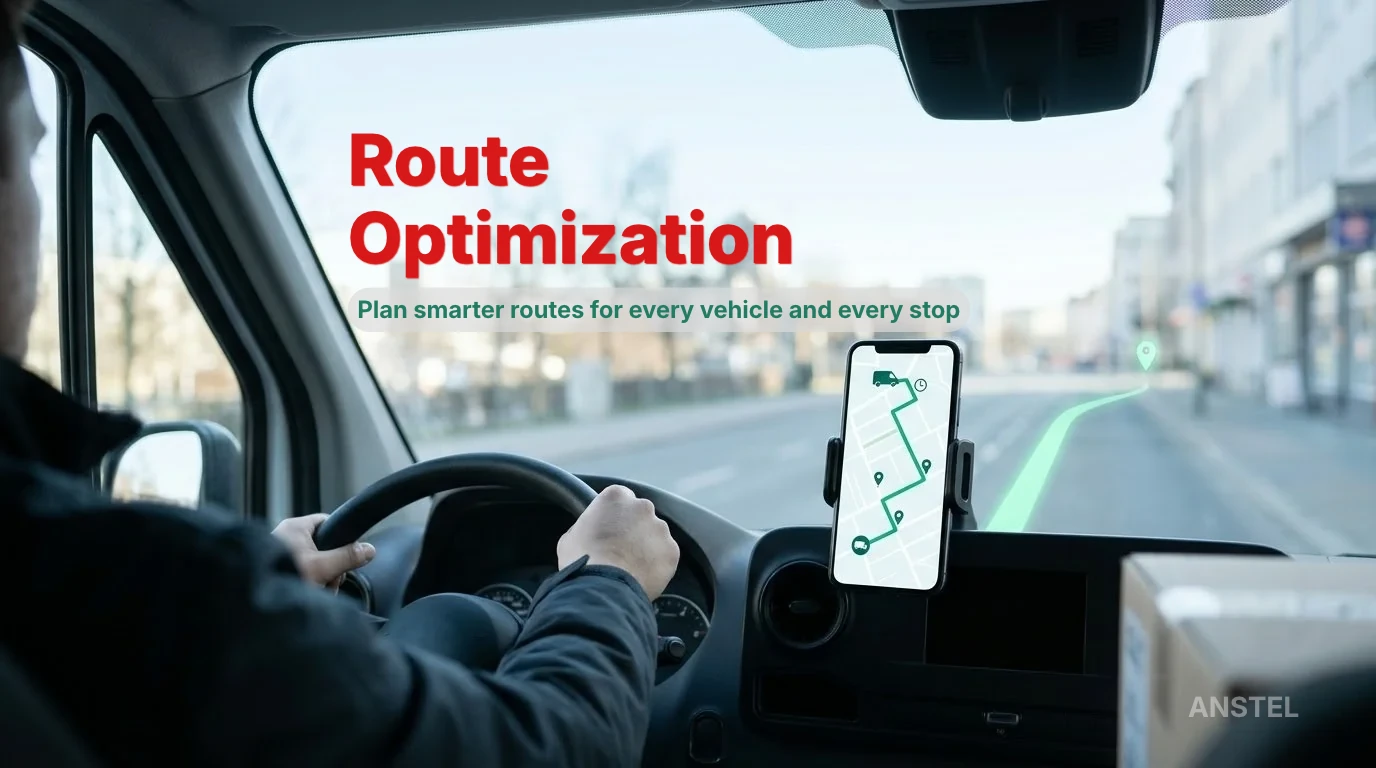
Route optimisation is the process of finding the most efficient set of routes for a fleet, taking into account every stop, delivery time window, vehicle capacity, driver shift, and live traffic. Route optimisation software does this automatically in minutes, which cuts kilometres driven, fuel costs, and overtime, while helping more deliveries arrive on time.
Planning routes by hand or with a navigation app works for a few stops. Once a business has dozens of vehicles, hundreds of stops, and customers expecting tight delivery windows, manual planning quickly becomes slow and expensive. The savings at scale can be large: UPS has said its ORION route optimisation system is expected to cut around 100 million miles and 10 million gallons of fuel a year. This guide explains what route optimisation is, how it differs from route planning, how the software works, the benefits, the main routing strategies, how to choose software, and the KPIs to track.
What this guide covers
- What route optimisation is
- Route planning vs route optimisation
- How route optimisation software works
- Benefits of route optimisation
- Static, dynamic, and real-time routing
- Signs you need route optimisation software
- How to choose software, and KPIs to track
- FAQs
What Is Route Optimization?
Route optimisation means deciding which vehicle serves which stops, in what order, and by which roads, so the whole fleet completes its work at the lowest cost while meeting every customer promise. It considers far more than distance:
- Number and location of stops
- Customer delivery or service time windows
- Vehicle capacity, type, and restrictions
- Driver shifts, breaks, and skills
- Traffic patterns and live road conditions
- Time needed at each stop
- Priorities, such as urgent or high-value orders
Route Planning vs Route Optimization
Route planning puts a list of stops into a sensible order for one vehicle, usually based on distance. Route optimisation solves the problem for the whole fleet at once, balancing distance, time windows, capacity, shifts, and traffic, and can re-plan during the day when something changes. A navigation app can give turn-by-turn directions between stops, but it doesn't decide which vehicle should do which job or how to meet every time window across the fleet.
How Route Optimization Software Works
- Import orders: addresses, time windows, and order details come in from your order system, spreadsheet, or e-commerce platform.
- Geocode addresses: each address is turned into an exact map location, and unclear addresses are flagged.
- Apply constraints: vehicles, capacities, shifts, breaks, and business rules are added.
- Optimise: algorithms compare many possible combinations to find efficient routes for the whole fleet.
- Dispatch: routes are sent to drivers' mobile apps with navigation and stop details.
- Track and adjust: live GPS tracking shows progress, updates arrival times, and re-plans when delays, cancellations, or new orders appear.
- Report: planned and actual routes are compared to find improvements.
Benefits of Route Optimization
- Lower fuel costs: fewer kilometres and less time in traffic mean less fuel.
- More stops per vehicle: efficient routes let drivers complete more jobs in a shift, so you may need fewer vehicles.
- On-time deliveries: routes that respect time windows and traffic improve on-time rates and customer satisfaction.
- Accurate arrival times: customers get realistic ETAs and live updates.
- Less planning time: routes that took hours to plan by hand are ready in minutes.
- Safer, less stressful driving: realistic schedules with breaks reduce the pressure to speed, and some tools can avoid difficult turns or risky roads.
- Lower emissions: fewer kilometres and less idling cut carbon emissions.
Static, Dynamic, and Real-Time Routing
- Static routing: the same routes are used every day or week. It suits regular deliveries to the same customers, such as retail store replenishment, and is reviewed every few months.
- Dynamic routing: new routes are planned each day based on that day's orders and expected traffic. It suits parcel delivery, e-commerce, and field service.
- Real-time routing: routes keep changing during the day as new orders, cancellations, and delays come in. It suits on-demand delivery and emergency services.
Many businesses combine them, for example fixed routes for regular customers with dynamic routing for one-off orders.
Signs You Need Route Optimization Software
- Planning routes takes hours every day.
- Fuel and overtime costs are rising faster than revenue.
- Deliveries regularly miss their time windows.
- Customers often call to ask where their order is.
- Some drivers are overloaded while others finish early.
- You can't easily compare planned routes with what actually happened.
How to Choose Route Optimization Software
- Supports your constraints: time windows, vehicle types and capacities, shifts, breaks, and special rules such as cold chain or hazardous goods.
- Uses live traffic: routes and ETAs should reflect real conditions, with re-planning during the day.
- Handles local addresses: good geocoding matters, especially for Indian addresses with landmarks rather than exact street numbers.
- Includes a driver app: navigation, stop details, and digital proof of delivery.
- Connects to GPS tracking: live locations and planned-versus-actual reports.
- Integrates with your systems: order management, ERP, and e-commerce platforms.
- Offers clear reporting and local support.
Route Optimization KPIs to Track
- Kilometres driven per stop or per order
- Stops completed per vehicle per day
- On-time delivery rate
- Planned vs actual route distance and time
- Fuel cost per stop
- Vehicle utilisation
- Time spent planning routes
- Customer calls about delivery status
How Anstel Helps
Anstel's Autonautics platform combines route planning with live GPS tracking, so fleets can plan efficient routes, follow vehicles in real time, share accurate arrival times, and compare planned and actual routes in one dashboard. Geofences record arrivals and departures automatically, and reports show where routes, drivers, and customer sites can improve.
Frequently Asked Questions
What is route optimisation?
Route optimisation is the process of finding the most efficient routes for a fleet, considering stops, time windows, vehicle capacity, driver shifts, and traffic, so the work is done at the lowest cost while meeting customer promises.
What is the difference between route planning and route optimisation?
Route planning orders the stops for a single route, usually by distance. Route optimisation plans the whole fleet at once, balancing many constraints, and can re-plan during the day.
Can Google Maps optimise routes?
Navigation apps can give directions and order a small number of stops, but they don't assign work across a fleet or handle time windows, vehicle capacity, and driver shifts the way route optimisation software does.
How much can route optimisation save?
Savings depend on the fleet and how routes are planned today. Fleets moving from manual planning usually see fewer kilometres, lower fuel and overtime costs, and more stops per vehicle. UPS expects its ORION system to save about 100 million miles a year.
What is dynamic route optimisation?
Dynamic route optimisation plans new routes each day, or during the day, based on current orders, traffic, and delays, instead of using the same fixed routes.
Who needs route optimisation software?
Any business with several vehicles and many stops, including parcel and e-commerce delivery, distribution, food and grocery delivery, field service, waste collection, and healthcare home visits.
Plan Smarter, Drive Less
Route optimisation turns route planning from a daily chore into a competitive advantage: fewer kilometres, lower costs, and more on-time deliveries. Start by measuring today's routes, then let the software find the savings.
Get in touch with the Anstel team to see how route optimisation and live tracking could work for your fleet.