








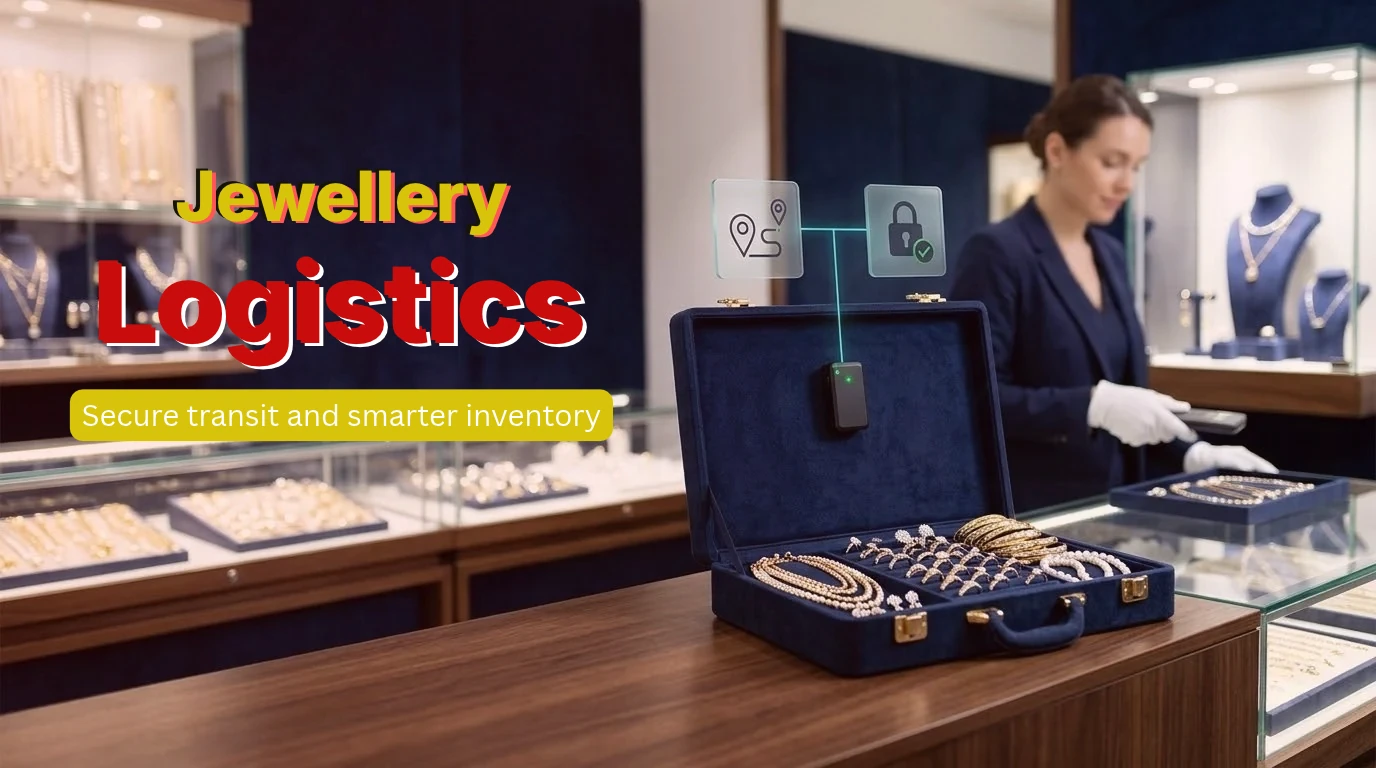
Connected logistics and IoT help the jewellery industry by tracking high-value stock wherever it moves: from workshops and vaults to showrooms, exhibitions, and customers. GPS trackers, tamper and route alerts protect consignments in transit, RFID tags make stock counts fast and accurate, and analytics show which pieces sell where. The result is lower risk of theft and loss, less stock tied up in the wrong place, and better decisions across every store.
Few businesses move as much value in such small packages as jewellers. A single case can carry gold, diamonds, and finished pieces worth crores, and it may change hands several times between the workshop, the vault, the showroom, and trade shows. This guide explains where jewellery is most at risk, how IoT protects consignments in transit, how connected inventory works in showrooms, and how to get started.
What this guide covers
- Why jewellery logistics needs extra protection
- Where jewellery is most at risk
- How IoT protects jewellery in transit
- Connected inventory in workshops and showrooms
- Sales and store performance analytics
- Benefits for jewellers
- FAQs
Why Jewellery Logistics Needs Extra Protection
- Very high value in a small space: one consignment can be worth more than the vehicle carrying it, which makes it an attractive target.
- Frequent movement: stock moves between manufacturers, karigars and workshops, vaults, showrooms, exhibitions, and customers, and every move is a risk.
- Insurance requirements: insurers expect clear procedures, secure transport, and records of where stock was at all times.
- Large, varied inventory: thousands of unique pieces are hard to count and locate by hand, so errors and shrinkage go unnoticed.
- Traceability: customers and regulators increasingly expect proof of purity and origin. In India, for example, most gold jewellery must carry a BIS hallmark with a unique six-digit HUID code.
Where Jewellery Is Most at Risk
- Workshop: gold, stones, and finished pieces are issued to craftspeople and returned, so every check-out and check-in must be recorded.
- Vault: stock must be counted regularly, and access to the vault logged.
- In transit: consignments between sites, to exhibitions, and to customers are the most exposed, especially on predictable routes and at stops.
- Showroom and exhibitions: pieces are handled by staff and customers all day, and trade-show stock moves in and out of temporary displays.
How IoT Protects Jewellery in Transit
Connected logistics turns every consignment and vehicle into something managers can watch in real time:
- Live GPS tracking: every vehicle carrying stock appears on a live map, with location updates every few seconds and a full history of each trip.
- Geofences and approved routes: alerts when a vehicle leaves its planned route, stops somewhere unexpected, or enters or leaves a site.
- Tamper and power alerts: warnings if a tracker is disconnected, its power is cut, or a secure case or door is opened unexpectedly.
- Panic or SOS buttons: staff can call for help with one press, sending their exact location.
- After-hours alerts: movement outside approved times is flagged straight away.
- Hidden backup trackers: a small battery-powered tracker inside a case or vehicle continues reporting even if the main device is found.
- Proof of handover: the time and place of each delivery is recorded, which helps settle disputes and supports insurance claims.
If something does go wrong, from a road accident to an attempted robbery, the team knows immediately where the consignment is and can send help or alert the police.
Connected Inventory in Workshops and Showrooms
RFID tags attached to individual pieces or trays let staff count a whole display or safe in minutes with a handheld reader, instead of counting piece by piece. This brings several benefits:
- Fast, accurate stock counts: daily or even shift-by-shift counts become practical, so missing pieces are noticed quickly.
- Locate any piece: staff can find which tray, safe, or store holds a specific item.
- Track workshop movements: materials and pieces issued to craftspeople are checked out and in automatically.
- Exhibition control: every piece sent to a trade show is accounted for when it leaves and when it returns.
- Smarter stock levels: combining inventory with sales data shows slow-moving items, so they can be moved to stores where they sell better, and fast sellers can be reordered before they run out.
Sales and Store Performance Analytics
When inventory and sales data come together in one dashboard, managers can measure performance by product category, store, region, and salesperson. They can see which designs sell where, find underperforming stores or ranges, and decide where to send stock. For businesses with many outlets, these insights help plan collections, staffing, and promotions based on facts rather than guesswork.
Connected equipment in manufacturing also helps. Sensors on casting, polishing, and cutting machines can warn of faults early, so maintenance is planned before a breakdown stops production.
Benefits for Jewellers
- Lower risk of theft and loss in transit, in the workshop, and on the shop floor.
- Faster response when something goes wrong, with exact locations and alerts.
- Accurate stock at all times, with less shrinkage and fewer counting errors.
- Better insurance position, with clear records and security procedures.
- Less capital tied up in the wrong stock or the wrong store.
- Data-driven decisions on ranges, stores, and staffing.
How Anstel Helps
Anstel provides 4G vehicle and asset trackers and the Autonautics platform to monitor high-value consignments. Managers see every vehicle on a live map, with trip history, geofence alerts when vehicles enter or leave sites or approved areas, after-hours movement alerts, and reports in one dashboard. Talk to the Anstel team about tracking options for your vehicles, cases, and exhibition stock.
Frequently Asked Questions
How is IoT used in the jewellery industry?
Jewellers use IoT for GPS tracking of high-value consignments, tamper and route alerts during transport, RFID tags for fast stock counts and locating pieces, sensors on manufacturing equipment, and analytics that combine sales and inventory data across stores.
How can jewellery be tracked during transport?
Vehicles and secure cases can carry GPS trackers that report location every few seconds, with geofences on approved routes, alerts for unplanned stops, tamper and power-cut alerts, panic buttons, and hidden backup trackers. Managers see everything on a live map and get alerts instantly.
What is RFID jewellery tracking?
RFID jewellery tracking uses small radio tags attached to pieces or trays. A handheld or fixed reader can count and identify many tagged items at once without line of sight, which makes stock counts much faster and more accurate than counting by hand.
How does connected logistics reduce jewellery theft?
It gives real-time visibility of where every consignment is, alerts managers to route changes, unexpected stops, and tampering, and records every handover. Thieves have less time to act, and the business can respond quickly with exact locations.
Can IoT help jewellers manage inventory across many stores?
Yes. Combining RFID stock data with sales data shows which pieces are in which store and how fast they sell, so slow-moving stock can be moved to stores where it sells better and popular designs can be reordered in time.
Is GPS tracking useful for jewellery exhibitions?
Yes. Tracking vehicles and cases going to and from trade shows, combined with RFID counts when stock leaves and returns, makes sure every piece sent to an exhibition is accounted for.
Protect Every Piece, Wherever It Goes
In the jewellery business, every movement of stock is a moment of risk. Connected logistics and IoT make those movements visible, from the workshop to the customer, while giving jewellers the data to run their stores more profitably.
Get in touch with the Anstel team to plan tracking for your consignments and stock.