

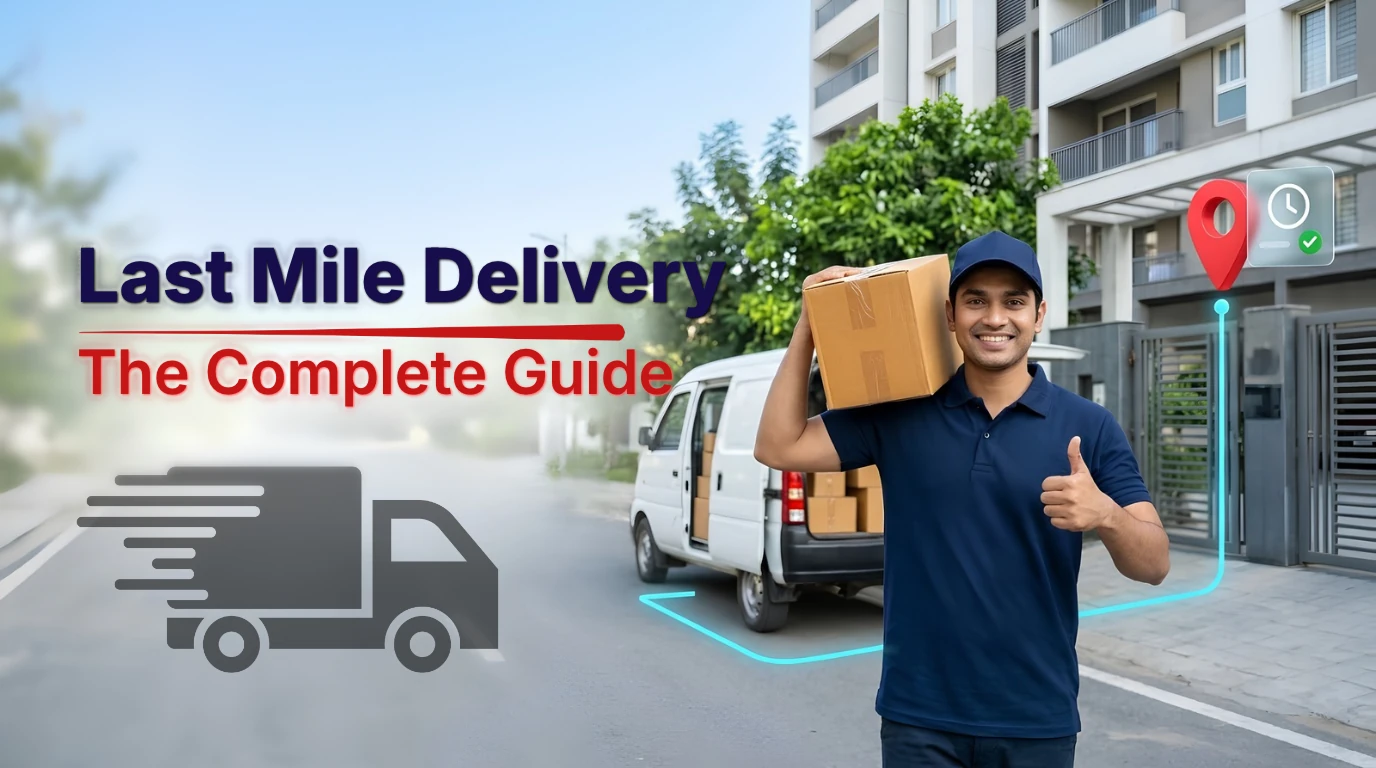
Last mile delivery is the final step of a delivery, when goods travel from a local hub, warehouse, or store to the customer's door. It is the part customers see, the part that decides whether an order arrives on time, and usually the most expensive part of the whole journey.
A Capgemini Research Institute study found that the last mile accounts for 41% of overall supply chain costs. In India, the pressure keeps rising: quick commerce reached $10–11 billion in gross merchandise value in 2025 after doubling every year since 2023, and Bain & Company projects it to reach $65–70 billion by 2030. Customers now expect deliveries in days, hours, or even minutes.
This guide explains how last mile delivery works, the main delivery models, why it costs so much, and the challenges Indian businesses face. It then sets out 12 practical ways to improve your deliveries, how real-time tracking and digital tools transform the last mile and the wider supply chain, and the KPIs that show whether it is working.
What this guide covers
- What is last mile delivery?
- How last mile delivery works
- Last mile delivery models
- Why last mile delivery is so expensive
- Last mile delivery challenges in India
- 12 ways to improve last mile delivery
- How real-time tracking improves last mile delivery
- How the last mile helps digitize the supply chain
- Last mile delivery KPIs
- How to choose last mile delivery software
- Last mile delivery trends
- FAQs
What Is Last Mile Delivery?
Last mile delivery is the movement of goods from the last stop in the supply chain, such as a distribution centre, dark store, or local hub, to the final delivery address. That address may be a home, an office, a shop, or a pickup point.
It is the third and final leg of road transport in a supply chain:
- First mile: from the supplier or factory to a warehouse.
- Middle mile: line-haul trips between warehouses and distribution centres.
- Last mile: from the local hub to the customer's door, usually in vans, three-wheelers, or two-wheelers making many short stops.
The term is not about distance. The last mile can be 500 metres in a city or 50 kilometres in a rural district. What makes it different is the number of stops, the small size of each drop, and the fact that it ends with a customer waiting at the door.
How Last Mile Delivery Works
Whether you deliver groceries, parcels, medicines, or spare parts, most last mile operations follow the same five steps:
- Order received: the order reaches the system with the delivery address, time window, and any special instructions.
- Route planning: orders are grouped by area and time window, assigned to vehicles based on capacity, and put into the most efficient stop sequence.
- Dispatch and loading: parcels are scanned and loaded in reverse stop order, and the driver receives the route on a phone app.
- Tracking in transit: the vehicle is tracked live, the customer receives an arrival time and a tracking link, and managers see delays as they happen.
- Delivery and proof: the driver hands over the parcel and records proof of delivery, such as an OTP, photo, or signature. Failed deliveries are rescheduled and returns are collected.
Last Mile Delivery Models
- In-house fleet: your own vehicles and drivers. It gives the most control over service and branding, but you carry the full cost of vehicles, drivers, and idle time.
- Third-party logistics (3PL) and courier partners: carriers that deliver for many businesses. They suit variable volumes and wide coverage, with less control over the customer experience.
- Gig and crowdsourced riders: independent riders who take deliveries through an app. This model scales quickly for food, grocery, and hyperlocal orders.
- Dark stores and micro-fulfilment centres: small warehouses placed close to customers, which make 10 to 30 minute quick commerce deliveries possible.
- Pickup points and lockers: customers collect orders from a nearby store or locker, which cuts failed deliveries and the cost of each drop.
Many businesses use a mix, for example an in-house fleet for core city routes and courier partners for outlying areas.
Why Last Mile Delivery Is So Expensive
The last mile costs more per kilometre than any other leg of the journey, for several reasons:
- Many small drops: a line-haul truck delivers one large load; a last mile vehicle may make 20 to 100 stops a day, each with parking, walking, and waiting time.
- Traffic and congestion: city traffic, narrow lanes, and restricted entry hours slow every stop.
- Failed deliveries: when the customer is out or the address cannot be found, the trip has to be repeated.
- Empty return trips: vehicles often head back to the hub with little or no load.
- Rising expectations: same-day and slot-based delivery leave less room to batch orders efficiently.
- Peak seasons: festive sales and big sale days multiply volumes, so businesses add vehicles and staff at higher rates.
Last Mile Delivery Challenges in India
- Unclear addresses: many addresses rely on landmarks rather than exact house numbers, so drivers lose time searching and calling customers.
- Traffic and road conditions: congestion, waterlogging in the monsoon, and narrow lanes make arrival times hard to predict.
- Failed first attempts: customers who are not home or do not answer calls lead to repeat trips and higher costs.
- Cash on delivery: COD orders take longer at the door, need cash handling, and are more likely to be refused.
- Festive peaks: sale seasons around Diwali and other festivals can multiply order volumes for weeks. In the first two days of the 2026 festive sales alone, e-commerce platforms handled an estimated 8–9 crore orders, according to Redseer.
- Returns: reverse pickups add stops and need their own planning and proof.
- Driver safety and fatigue: long shifts and pressure to meet time slots push riders and drivers to rush, which raises the risk of reckless driving.
- Rural and remote coverage: long distances between drops and weak mobile signal make rural deliveries slow and costly.
How to Improve Last Mile Delivery: 12 Practical Tips
Most last mile problems can be fixed with better planning, better data, and a few simple habits. These 12 tips work for retailers, e-commerce sellers, courier companies, and any business running its own delivery fleet.
1. Optimise Routes Every Day
Manual route planning cannot keep up with dozens of stops, changing orders, and city traffic. Route optimisation software works out the shortest, most cost-effective stop sequence in minutes, taking account of delivery windows, vehicle capacity, and road conditions, and re-plans during the day when new orders or cancellations come in. Shorter routes mean less fuel, less vehicle wear, and more drops per driver per day.
2. Track Every Vehicle and Delivery in Real Time
GPS tracking shows where every vehicle is and how each delivery is progressing, so managers can spot a delay and act before the customer notices. Alerts for unplanned stops, route changes, and late arrivals turn tracking into early warnings instead of a map nobody watches. Real-time tracking is so central to the last mile that it has its own section below.
3. Share a Live ETA with Customers
A customer who knows the driver will arrive in 15 minutes is far more likely to be home to receive the parcel. Send a live arrival time and delivery status by SMS, WhatsApp, or a tracking page, and update it automatically if the driver is running late. This cuts failed deliveries and "where is my order?" calls at the same time.
4. Automate Dispatch
Assigning dozens or hundreds of jobs by hand is slow and error-prone. Auto-dispatch assigns each delivery to the best driver based on location, route, vehicle capacity, and workload, and reassigns jobs when plans change. Dispatchers stop typing jobs into spreadsheets and handle only the exceptions that need a human decision.
5. Verify Every Address Before Dispatch
Incomplete addresses and wrong pin codes are a major cause of failed deliveries. Validate addresses at checkout, ask for a landmark and a reachable phone number, and save the exact drop location after the first successful delivery so the next one is faster.
6. Give Customers Delivery Choices
Speed matters, but so does convenience. Let customers choose a time slot, an alternative address such as an office, a safe place to leave the parcel, or a nearby pickup point or parcel locker, and give them an easy way to reschedule before the driver leaves. The more control customers have, the more parcels are delivered first time.
7. Confirm Cash on Delivery Orders
COD orders are more likely to be refused, and every return-to-origin (RTO) shipment costs you the delivery and the return trip. Confirm high-value and first-time COD orders by call, SMS, or WhatsApp before dispatch, and encourage prepaid payment with a small incentive where it makes sense.
8. Capture Digital Proof of Delivery
Paper delivery slips get lost and are hard to check. Digital proof of delivery records a photo, a signature or OTP, the time, and the location on the driver's phone, and stores it against the order straight away. It settles "I never received it" disputes in minutes.
9. Move Stock Closer to Customers
The shorter the last mile, the cheaper and faster it is. Retailers can use their stores as small fulfilment points for nearby orders, and online sellers can use local hubs, dark stores, or shared micro-fulfilment space where demand is high. Even one extra hub in a busy zone can cut kilometres per delivery significantly.
10. Choose the Right Delivery Partner and Track Their Performance
If you hand deliveries to a courier or delivery partner, check the regions and sectors they cover, their delivery options, and whether their technology connects easily with yours. Then track partners on the same measures you use for your own fleet: on-time delivery, first-attempt success, delays, route diversions, and damage, so you can compare them on facts.
11. Keep Drivers Safe and Supported
Drivers and riders are the face of your brand at the customer's door. Give them a simple driver app with clear job lists and navigation, realistic routes with time for breaks, and an SOS button for emergencies. Alerts for speeding and harsh braking help you coach drivers, reduce accidents, and cut fuel use, and engine data supports maintenance before a vehicle breaks down mid-route.
12. Review Your KPIs Every Week and Ask for Feedback
What gets measured gets improved. Review the KPIs listed later in this guide every week, ask customers to rate each delivery in a single tap, and read the comments. Together, the numbers and the feedback show which areas, time slots, drivers, or partners need attention.
How Real-Time Tracking Improves Last Mile Delivery
Customers expect same-day or even same-hour delivery, and a clear answer when they ask where their order is. Real-time tracking and tracing gives your operations team and your customers the same live picture of every delivery:
- Visibility of every vehicle: managers see where each vehicle is, which deliveries are done, and which are running late, on one live map.
- Problems spotted early: alerts for delays, unplanned stops, and route changes let teams act before a delivery fails.
- Geofence records: automatic arrival and exit times at hubs and customer locations show exactly how long each stop takes.
- More secure shipments: when a parcel goes missing, the vehicle's route history shows where it went and when, so the parcel can be traced quickly instead of written off as "lost in transit".
- Fair carrier and driver data: task times, successful, failed, and delayed deliveries, and diversions from the planned route give an objective view of drivers and delivery partners.
- Happier customers: a live ETA and early notice of delays mean fewer missed deliveries, fewer calls, and better ratings.
- Better planning: months of tracking data show real travel times by area and time of day, which makes future routes and arrival times more accurate.
How the Last Mile Helps Digitize the Supply Chain
Customers now track an order from the moment they place it, and many won't buy without a clear delivery date. That expectation pushes digital tools back through the whole supply chain, and the last mile is usually where it starts. Once delivery runs on one digital platform instead of spreadsheets, phone calls, and paper slips, its data improves every step before it:
- Plan and schedule transport: telematics, IoT sensors, and map data help planners schedule routes, pickups, and drop-offs in one system, using both live conditions and past trips. Decisions are faster, fewer details are lost between team members, and there is less room for human error.
- Monitor in real time: a live view of vehicles, orders, and stock shows bottlenecks as they form and exactly which orders they affect, so teams can act on problems such as bad weather or a breakdown and update affected customers straight away.
- Predict delays: comparing historical delivery data with what is happening now shows which routes, areas, and times are likely to run late, so plans can change before customers are let down.
- Forecast demand and stock: order history, seasonality, promotions, and events help forecast demand, so hubs, dark stores, and warehouses carry the right stock. For perishable goods, this means fewer stock-outs and less waste.
- One network, one platform: fast-growing delivery businesses often run a complex mix of warehouses, dark stores, and local vendors. Bringing them onto one platform keeps every team working from the same data.
Last Mile Delivery KPIs to Track
- On-time delivery rate: deliveries made in the promised window ÷ total deliveries × 100
- First-attempt delivery rate: deliveries completed on the first attempt ÷ total deliveries × 100
- Cost per delivery: total last mile cost ÷ number of deliveries
- Deliveries per vehicle per day: total deliveries ÷ (vehicles × working days)
- Arrival time accuracy: average gap between promised and actual arrival time
- Kilometres per delivery: total km driven ÷ number of deliveries
- Return pickup completion rate: returns collected on time ÷ returns scheduled × 100
- Customer rating: average delivery rating or NPS from post-delivery feedback
How to Choose Last Mile Delivery Software
Use this checklist when you compare platforms:
- Route optimisation that handles time windows, vehicle capacity, and live re-routing.
- Live tracking with customer tracking links and arrival-time notifications.
- Proof of delivery by OTP, photo, and signature.
- A simple driver app that works on basic Android phones and in areas with weak signal.
- Support for mixed fleets, including two-wheelers, three-wheelers, vans, and partner vehicles.
- Returns and COD handling, with reconciliation reports.
- Integrations with your order management, ERP, or e-commerce platform through APIs.
- Reports on the KPIs above, by hub, area, and driver.
- Local support and a clear total cost, including devices, subscriptions, and setup.
Last Mile Delivery Trends
- Quick commerce: dark stores and 10 to 30 minute deliveries are moving from groceries into electronics, beauty, and pharmacy.
- Electric delivery vehicles: electric two-wheelers and three-wheelers cut running costs on short, repeated city routes, and need tracking of battery charge and range.
- Hyperlocal fulfilment: stock is moving closer to customers through micro-warehouses and partner stores.
- Smarter routing: routing tools increasingly use historical traffic and delivery data to predict arrival times more accurately.
- Open networks: open commerce networks such as ONDC are making it easier for smaller sellers to plug into shared delivery partners.
- Greener deliveries: customers and large shippers increasingly ask about the emissions of each delivery.
How Anstel Helps You Deliver the Last Mile
Anstel's Last Mile module, part of the Autonautics platform, brings delivery operations and fleet tracking into one system:
- Routes and dispatch: optimised multi-stop routes, with jobs assigned and reassigned to drivers as new orders and changes come in.
- Driver app: a mobile app for assignments, navigation, shift check-in and check-out, an SOS alert, and real-time notifications.
- Live ETA for customers: customers see delivery status and a live arrival time as the driver approaches.
- Proof of delivery: digital signatures, photos, and timestamps captured on the driver's phone and stored against each job.
- Fleet tracking: live location, geofences, driving behaviour alerts, and vehicle health data from Anstel Connected Fleet.
- Reports: complete delivery history and analytics to find delays and improve performance.
Frequently Asked Questions
What is last mile delivery?
Last mile delivery is the final step of the delivery process, when goods move from a local hub, warehouse, or store to the customer's address. It usually involves many short trips with small drops, and it is the most visible and often the most expensive part of the supply chain.
Why is last mile delivery so expensive?
Last mile delivery is expensive because each vehicle makes many small drops, city traffic slows every stop, failed deliveries have to be repeated, vehicles often return empty, and customers expect fast, slot-based delivery. A Capgemini Research Institute study found that the last mile accounts for 41% of overall supply chain costs.
What is the difference between first mile, middle mile, and last mile?
The first mile moves goods from the supplier or factory to a warehouse, the middle mile moves them between warehouses and distribution centres, and the last mile delivers them from the local hub to the customer's door.
How can I reduce last mile delivery costs?
You can reduce last mile costs by optimising routes, grouping orders by area and time window, sharing accurate arrival times so customers are home, using digital proof of delivery, cutting idle time, offering pickup points, and tracking cost per delivery and first-attempt delivery rate every week.
What is last mile delivery software?
Last mile delivery software plans routes, assigns orders to drivers, tracks vehicles live, sends customers arrival times and tracking links, records proof of delivery, and reports on delivery performance, usually through a web dashboard and a driver app.
How can I improve last mile delivery?
Start with three changes: optimise routes every day, track every vehicle in real time, and share a live ETA with customers. Then automate dispatch, verify addresses, offer delivery choices, confirm COD orders, capture digital proof of delivery, and review your delivery KPIs every week.
How does real-time tracking improve last mile delivery?
Real-time tracking shows where every vehicle and delivery is, alerts managers to delays and unplanned stops, and gives customers a live ETA. This reduces failed deliveries, helps trace missing parcels, provides fair performance data on drivers and partners, and cuts customer service calls.
How does the last mile help digitize the supply chain?
When deliveries run on a digital platform, live tracking, delivery records, and customer data flow back to planners. They use them to schedule transport, spot bottlenecks, predict delays, and forecast demand, replacing spreadsheets and phone calls with one shared, real-time view.
Win the Last Mile
The last mile is where customers judge your whole operation. You don't need to change everything at once: start with routes, real-time tracking, and live arrival times, measure the results for a month, and build from there. Done well, the last mile delivers more orders per vehicle, fewer failed attempts, lower costs, and a supply chain that runs on real data.
Get in touch with the Anstel team to see last mile delivery management working on your routes.