









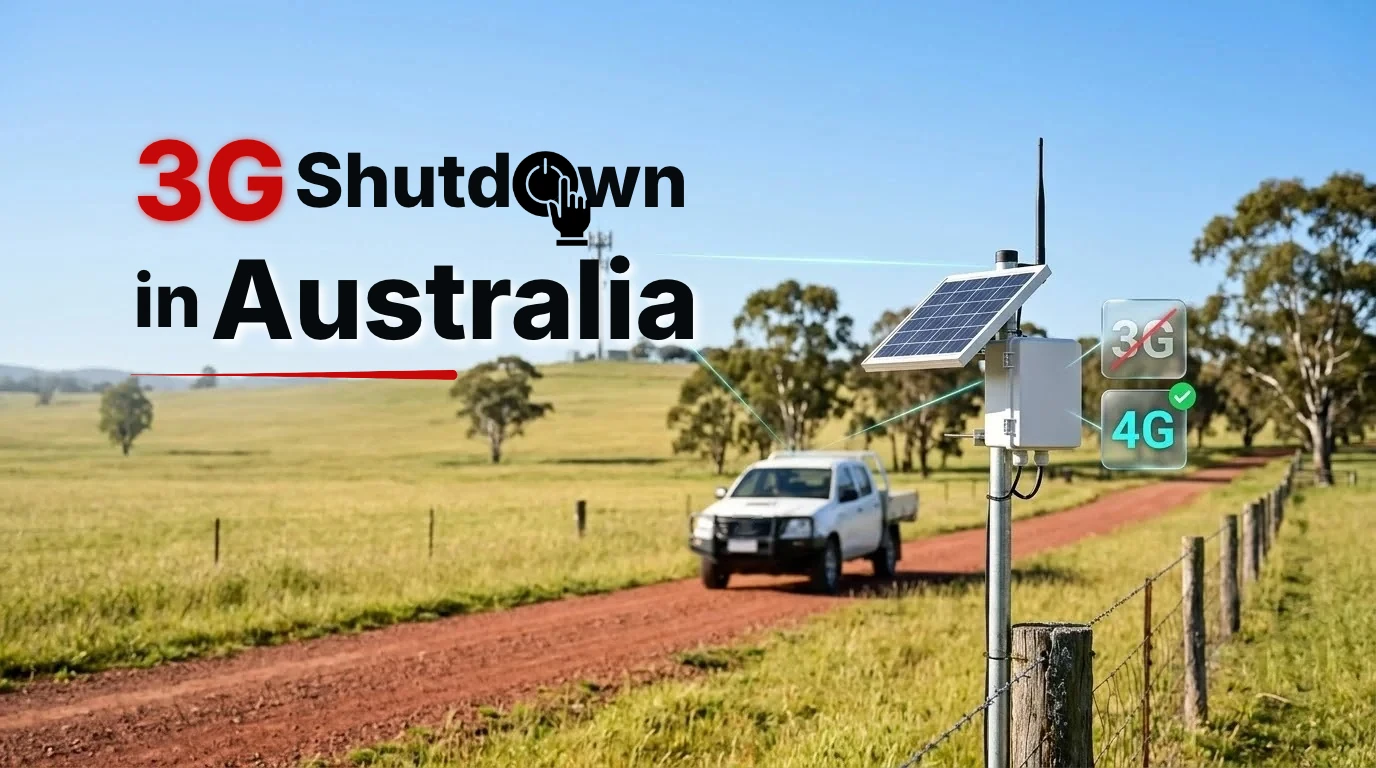
Australia's 3G networks are gone. TPG Telecom (Vodafone) completed its switch-off in January 2024, and Telstra and Optus began switching off 3G on 28 October 2024. Any IoT or business device that relied on 3G has lost its connection: vehicle trackers, security and medical alarms, lift phones, remote sensors, meters, and older routers and payment terminals. Some devices that support 4G have also failed, because of missing bands, weaker coverage on site, or voice features that still depended on 3G.
Many of these devices fail silently. A tracker stops reporting, an alarm stops reaching its monitoring centre, or a sensor stops sending data, and nobody notices until it matters. This guide explains which devices were affected, why some 4G devices still fail, the security risks of leftover 3G equipment, and a practical plan to find and replace every affected device.
What this guide covers
- How Australia switched off 3G
- Which business and IoT devices were affected
- Why some 4G devices still don't work
- The business impact
- Security risks of leftover 3G devices
- How to find and replace 3G devices
- What should replace a 3G device
- What it means for fleets
- Will 4G be switched off next?
- FAQs
How Australia Switched Off 3G
Mobile carriers switch off old networks to reuse the radio spectrum for faster, more efficient 4G and 5G services, a process known as re-farming. 3G used a different radio technology from 4G and 5G, and running separate 3G equipment for a shrinking number of users no longer made sense. In Australia, the switch-off happened in stages:
- TPG Telecom (Vodafone): began switching off 3G on 15 December 2023 and completed it in January 2024. Customers of TPG-based providers such as iiNet, TPG, and Kogan Mobile were affected.
- Telstra: originally planned for June 2024, then delayed. It began switching off 3G on 28 October 2024. Customers of Telstra-based providers such as Boost Mobile and Belong were also affected.
- Optus: originally planned for September 2024, then delayed. It also began switching off 3G on 28 October 2024. Customers of Optus-based providers such as amaysim were affected.
The Telstra and Optus delays followed concerns that some older 4G phones could not call Triple Zero (000) without 3G. From 28 October 2024, rules made by the Australian Communications and Media Authority (ACMA) require carriers to identify, notify, and block mobile phones that cannot reach the emergency call service. If you are checking personal phones, our consumer guide "How to Check 3G Device Compatibility in Australia" in the Anstel Knowledge Center covers this step by step.
Which Business and IoT Devices Were Affected?
The Australian Government confirms that non-phone and IoT devices that relied on 3G have lost functionality, including some smart watches, tablets, security systems, agricultural monitoring equipment, personal medical alarms, and lift phones. For businesses, the most common affected devices are:
- Vehicle trackers and fleet telematics: older GPS trackers stop sending location, trips, driving hours, and engine data.
- Security and monitored alarms: alarm panels that used a 3G communicator may no longer reach the monitoring centre.
- Personal medical alarms: pendants and base units for older people and people living alone can fail to call for help.
- Lift emergency phones: the phone inside the lift car can go dead, which is a safety and compliance problem for building owners.
- Farm, environmental, and site monitoring: weather stations, water tank and flood sensors, pumps, and remote cameras in regional areas.
- Meters and remote telemetry: utility meters, solar and battery systems, and industrial equipment that report readings remotely.
- Routers, backup links, and payment terminals: older 3G routers and backup connections, and older mobile EFTPOS terminals that only used 3G.
- Vehicle safety features: some older cars used 3G for automatic crash alerts, roadside assistance, or SOS buttons. Owners should check with the manufacturer or dealer.
Why Some 4G Devices Still Don't Work
A device labelled "4G" is not always ready for life without 3G. The most common problems are:
- Missing Band 28: the 700 MHz band carries 4G a long way, especially in regional Australia. Devices without it can lose coverage where 3G used to reach.
- Weaker coverage on site: some locations only had 3G coverage, or had reception by chance well outside the official coverage area. Equivalent 4G service is not guaranteed in those places.
- Voice still on 3G: alarms, lift phones, and medical alarms that make voice calls need VoLTE. Devices that only made calls over 3G stop calling, even if their data still works.
- Hardware differences: antennas bought for 3G may not suit 4G frequencies, and power and connector specifications can differ.
- Old settings and SIMs: outdated firmware, network settings, or SIM cards can stop a capable device connecting properly.
The Business Impact
- Service disruption: devices that stop connecting interrupt tracking, monitoring, payments, and remote control of equipment.
- Safety and compliance: failed alarms, lift phones, and medical alarms put people at risk and can breach building, workplace, and care obligations.
- Lost data: missing location, driving hours, meter readings, or sensor data can affect billing, compliance records, and decisions.
- Hidden replacement costs: beyond the devices themselves, there are new antennas, installation visits, configuration, and testing. Hardware sourced from overseas can take months to arrive, and well-run migrations of large IoT fleets often take 12 to 18 months.
Security Risks of Leftover 3G Devices
Devices that still carry 3G modules, or systems that were never updated, are also a security risk:
- No more updates: manufacturers stop supporting 3G-era devices, so security flaws are never patched.
- Weaker older protection: 4G uses stronger encryption algorithms such as AES, mutual authentication between device and network, integrity protection to detect tampering, and temporary identifiers that make tracking harder.
- Upgrade scams: criminals pose as telcos offering "3G upgrades" to trick people into handing over personal details or installing malware. Only deal with your provider through its official channels.
- Rushed replacements: new devices installed in a hurry often keep default passwords and open settings.
When you replace devices, secure them from day one: change default passwords, connect them through a private APN or VPN rather than the open internet, use firewalls to control their traffic, keep firmware updated, and review access and security settings regularly.
How to Find and Replace 3G Devices
- Find every device. List all equipment with a SIM card. Ask your carrier for a report of SIMs that have not connected since the switch-off, and look for trackers, alarms, or sensors that went quiet in late 2024.
- Check what you need. For each device, confirm 4G support, Band 28, VoLTE if it makes calls, and actual coverage where it is installed. Work out how much data it sends and whether it needs long battery life.
- Plan the replacement. Talk to suppliers about compatible hardware, costs, and lead times. Consider dual-SIM or failover options for critical devices.
- Test before rolling out. Trial new devices on site, check they connect reliably, and confirm data reaches your systems and alarms reach the right people.
- Update settings and records. Configure network settings, firmware, and security on every device, and update your asset register.
- Monitor after the change. Watch for devices that drop offline, weak signal, or missing data in the first weeks.
- Communicate. Tell staff, tenants, customers, and anyone relying on the devices what is changing and when.
What Should Replace a 3G Device?
The right replacement depends on what the device does, not just on choosing the newest network:
- 4G LTE: for alarms, lift phones, routers, and payment terminals that need voice calls or more data. Choose devices with Band 28 and VoLTE.
- LTE-M: for vehicle trackers, wearables, and medical alarms that move around, send small amounts of data, and need good battery life and coverage.
- NB-IoT: for fixed meters and sensors that send tiny amounts of data and need to run for years on a battery.
- Satellite IoT and other low-power networks: for remote farms, mines, and sites beyond mobile coverage.
LTE-M and NB-IoT are part of the 5G family for massive IoT, so they are a long-term choice rather than a stopgap. Check that your carrier supports the network you choose where your devices actually operate.
What the 3G Shutdown Means for Fleets
Fleets were among the businesses most affected, because GPS trackers record location, trips, driving hours, and safety events that companies rely on every day. Signs of a 3G problem include vehicles that stopped reporting in late 2024, gaps in trip history, or trackers that only report in some areas. Replacement trackers should support 4G with Band 28 or LTE-M, and fleets in regional areas should test coverage on their actual routes before rolling out.
Will 4G Be Switched Off Next?
No Australian carrier has announced a date to switch off 4G. 4G remains the backbone of mobile coverage, especially in regional areas, and is expected to run alongside 5G for many years. Even so, the 3G experience is a lesson: choose devices that support current networks and long-term IoT technologies such as LTE-M and NB-IoT, keep an up-to-date register of every connected device, and plan replacements well before any future switch-off.
How Anstel Helps
Anstel works with telecom operators and businesses across Australia, New Zealand, Fiji, Papua New Guinea, and India on IoT and connected fleet solutions. Its team checks whether existing devices are compatible, helps choose replacement trackers and sensors that work on current networks, and brings them into the Autonautics platform for live tracking, alerts, and reporting in one dashboard.
Frequently Asked Questions
When did 3G shut down in Australia?
TPG Telecom (Vodafone) completed its 3G switch-off in January 2024. Telstra and Optus began switching off their 3G networks on 28 October 2024, after delaying their original June and September 2024 dates, and 3G was gone from all national networks by November 2024.
Do IoT devices still work after the 3G shutdown?
Devices that relied only on 3G no longer connect. Devices that support 4G usually keep working, but only if they support the right bands, such as Band 28, have VoLTE for voice calls, and have 4G coverage where they are installed.
Which business devices were affected by the 3G shutdown?
Common examples include vehicle trackers, security and monitored alarms, personal medical alarms, lift emergency phones, farm and environmental sensors, meters and telemetry equipment, older routers and backup links, and older mobile payment terminals.
Why doesn't my 4G device work since the 3G shutdown?
The most common reasons are missing support for Band 28, weaker 4G coverage where the device is installed, voice calls that still relied on 3G instead of VoLTE, unsuitable antennas, or out-of-date firmware, settings, or SIM cards.
What should I replace a 3G IoT device with?
Use 4G LTE with Band 28 and VoLTE for devices that need voice or more data, LTE-M for trackers and wearables, NB-IoT for meters and fixed sensors, and satellite IoT for sites beyond mobile coverage.
Will 4G be shut down in Australia?
No Australian carrier has announced a 4G switch-off date, and 4G is expected to run alongside 5G for many years. Choosing devices that support LTE-M, NB-IoT, or 5G helps protect your investment for the long term.
Don't Let a Silent Device Become a Problem
The 3G networks have closed, but devices that relied on them may still be sitting in vehicles, buildings, and paddocks, quietly not working. A simple inventory, a check of each device, and a planned replacement with the right network keep your operations connected and secure.
Get in touch with the Anstel team to check your devices and plan the move to 4G and long-term IoT networks.