










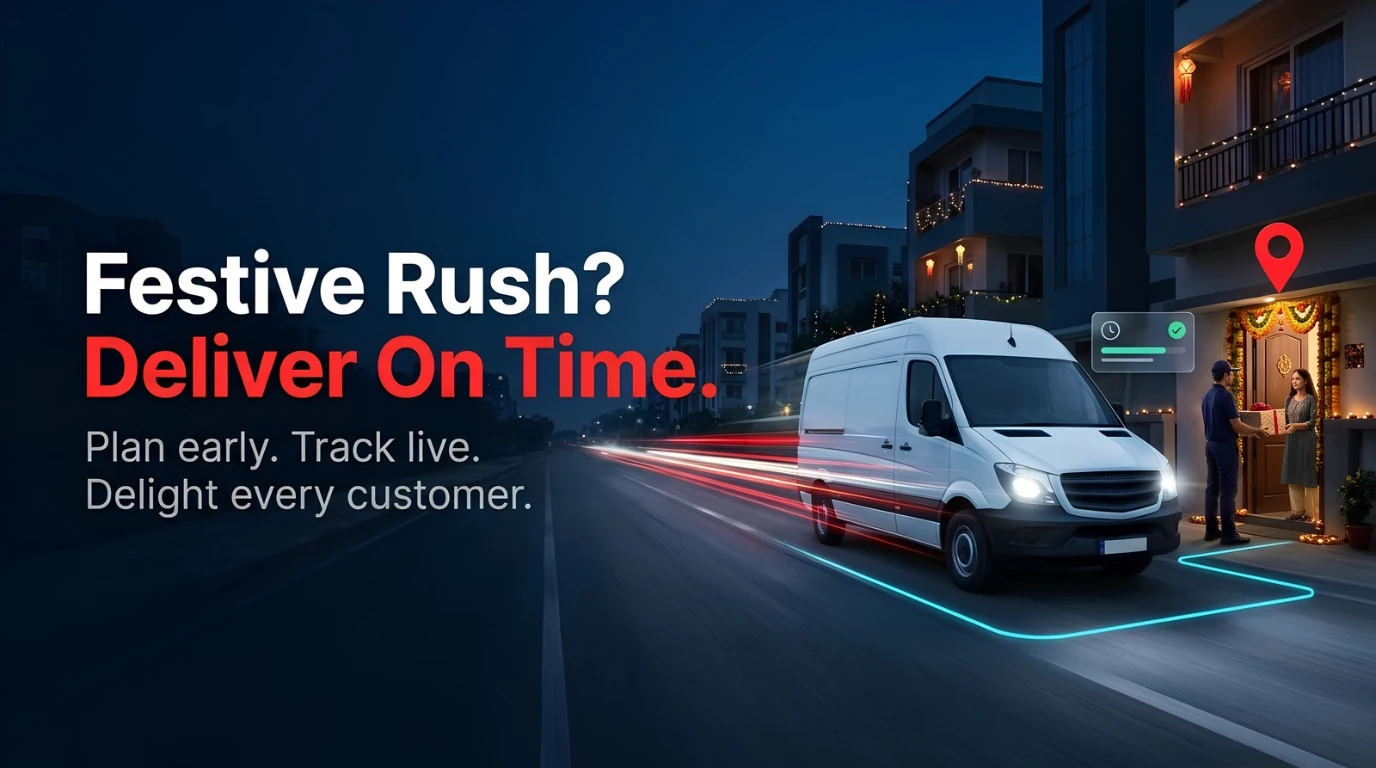
The festive season, from Navratri through Diwali and the year-end sales, is the busiest time of year for delivery fleets in India. Order volumes jump to several times their normal level, roads get more crowded, and customers still expect their parcels on time. The biggest festive season delivery challenges are order surges, rider shortages, traffic, failed deliveries, and breakdowns, and most of them can be reduced with early planning, real-time fleet tracking, and better route planning.
The scale is growing every year. In the first two days of the 2026 festive sales, e-commerce platforms sold goods worth about ₹24,200 crore across an estimated 8–9 crore orders, nearly six times the normal daily level, according to Redseer. Delivering those orders is expensive too: a global study by the Capgemini Research Institute found that the last mile makes up 41% of total supply chain costs.
Good festive season logistics comes down to preparation. This guide explains the eight biggest festive season delivery challenges, how to solve each one, a week-by-week preparation checklist, and the numbers to track during the peak.
What this guide covers
- Why the festive season tests delivery fleets
- 8 festive season delivery challenges
- How to solve festive delivery challenges
- Festive season delivery checklist
- KPIs to track during the peak
- How Anstel helps delivery fleets
- FAQs
Why the Festive Season Is the Hardest Test for Delivery Fleets
Festive demand does not just rise; it arrives in sharp spikes, in specific cities and pin codes, and often in the same few hours of the day. These figures show the size of the challenge:
- ₹24,200 crore in two days: e-commerce sales in the first two days of the 2026 festive sales, from 8–9 crore orders (Redseer).
- Nearly six times normal: sales in those two days ran at almost six times the usual daily level (Redseer).
- 300–400% above normal: daily order volumes in the final festive weeks of 2025, across brands on the EasyEcom platform (EasyEcom Diwali 2025 report).
- 55% from smaller cities: Tier 2 and Tier 3 cities accounted for 55% of orders during Diwali 2025, as reported by Inc42, which means longer routes and more scattered drops.
- 2.5–2.7 lakh temporary jobs: Adecco India expects festive temporary and gig hiring to grow 15–20% in 2026, and estimates a 10–15% gap between demand and supply in peak frontline roles.
- 41% of supply chain cost: the share taken by the last mile, the most expensive part of the journey (Capgemini Research Institute).
8 Festive Season Delivery Challenges
1. Order Surges Beyond Normal Capacity
Festive orders can reach several times the normal daily volume, and they peak in short windows. EasyEcom found that 45% of daily festive orders were placed between 9 AM and 1 PM. Hubs, vehicles, and riders sized for an ordinary week cannot keep up, so backlogs build and delivery promises slip.
2. Rider and Driver Shortages
Every courier, marketplace, and quick commerce company is hiring at the same time. Even when a city has enough riders overall, outer areas can still run short, and temporary staff need time to learn routes and processes, so riders hired late add little real capacity.
3. Traffic, Crowds, and Weather
Festival markets, processions, road closures, and late monsoon rain slow every route. Vehicles spend longer idling, each driver completes fewer drops per shift, and fuel costs rise.
4. Longer Routes to Smaller Cities
A growing share of festive orders comes from Tier 2 and Tier 3 cities and towns. These routes are longer, stops are further apart, and addresses are often harder to find, which stretches both vehicles and delivery times.
5. Bottlenecks at Hubs and Loading Bays
When orders arrive close to the final dispatch window, they can exceed the hourly capacity of loading bays and sorting lines. Vehicles waiting for an unloading slot at a marketplace facility can back up a carrier's whole distribution centre.
6. Failed Deliveries and Return to Origin (RTO)
Customers who are away for the festival, incomplete addresses, and cash-on-delivery orders refused at the door all lead to failed deliveries. Each failed attempt means a second trip or a return to origin (RTO), adding cost and taking up vehicle space in the busiest weeks of the year.
7. Vehicle Breakdowns at the Worst Time
Vehicles run longer hours and carry heavier loads during the peak. A breakdown in the middle of a route strands every parcel on board and pulls another vehicle off its own jobs.
8. Driver Fatigue and Safety
Longer shifts, night deliveries, and pressure to finish routes raise the risk of tiredness, speeding, and accidents. An accident in peak season costs far more than the repair: it removes a driver and a vehicle when both are hardest to replace.
How to Solve Festive Season Delivery Challenges
Most festive delivery problems are easier to prevent than to fix in the middle of the rush. These are the steps that make the biggest difference, and the challenges each one helps with:
Plan Capacity Early, by City and Pin Code
Use last year's delivery data to forecast volumes for each city and pin-code cluster, then book extra vehicles, hubs, and riders well before the sales begin. Bring temporary riders on board early so they know their routes before the peak. Helps with: order surges, rider shortages, hub bottlenecks.
Optimise Routes and Dispatch Every Day
Group deliveries by area, plan routes around traffic, time windows, and vehicle capacity, and re-plan daily as volumes change. Route optimisation means fewer kilometres per drop and more deliveries per vehicle per shift. Helps with: traffic delays, longer routes to smaller cities.
Track Every Vehicle in Real Time
Live GPS tracking shows where every vehicle is, which routes are running late, and which vehicles are idling. Geofences around hubs and customer sites record arrival and departure times automatically, so dispatchers can move jobs between vehicles before a delay becomes a missed promise. Helps with: traffic delays, hub bottlenecks, order surges.
Cut Failed Deliveries and RTO
Check addresses when the order is placed, confirm cash-on-delivery orders before dispatch, call or message customers before arrival, and share a live tracking link so they know when to expect the parcel. Delivery OTPs and photo proof of delivery reduce disputes. Helps with: failed deliveries and RTO.
Service Vehicles Before the Peak
Complete servicing for every vehicle before the festive sales begin, using mileage and engine-hour data rather than guesswork. During the peak, engine fault alerts and maintenance reminders help catch problems before they become roadside breakdowns. Helps with: vehicle breakdowns.
Monitor Driving and Manage Fatigue
Driver behaviour scores flag speeding, harsh braking, and long hours behind the wheel, and AI cameras can warn drivers in real time when they show signs of drowsiness or distraction. Set sensible shift limits and plan breaks into routes. Helps with: driver fatigue and safety.
Run the Peak from One Control Room
Bring live tracking, alerts, and delivery status into one dashboard during the peak. Exception alerts for late routes, long idling, route deviations, and vehicles stuck at hubs let a small team manage a much larger fleet. Helps with: every challenge above.
Festive Season Delivery Checklist
- 6–8 weeks before the sales: forecast volumes by city and pin code, confirm extra vehicles and hubs, start hiring and training riders, and service every vehicle.
- 2–4 weeks before: set up geofences around hubs and key customer sites, test routes and alerts, agree peak shift patterns, and brief customer support on tracking links and delivery updates.
- During the peak: re-plan routes daily, watch live exceptions from a control room, confirm cash-on-delivery orders before dispatch, and check driver hours every day.
- After the peak: review KPIs against the plan, record what failed and where, and service vehicles that ran the heaviest routes.
KPIs to Track During the Festive Peak
Measure these every day of the peak and compare them with a normal month:
- On-time delivery rate: deliveries made within the promised window ÷ total deliveries × 100.
- First-attempt delivery rate: parcels delivered on the first attempt ÷ total attempted × 100.
- RTO rate: orders returned to origin ÷ total orders shipped × 100.
- Deliveries per vehicle per day: how hard each vehicle is working.
- Cost per delivery: fuel, driver, and vehicle cost ÷ deliveries completed.
- Idle time: hours with the engine on while standing still, by vehicle and route.
- Average delay: the gap between estimated and actual arrival times.
How Anstel Helps Delivery Fleets in the Festive Season
Anstel's Autonautics platform brings fleet tracking and last mile delivery management into one system, so delivery teams can plan, track, and prove every drop during the busiest weeks of the year:
- Live tracking: GPS data from every vehicle, refreshed every few seconds, on web and mobile.
- Last mile and dispatch: job scheduling, dispatch management, and route optimisation to plan each day's deliveries.
- Geofences and alerts: automatic arrival and departure records, plus alerts for delays, idling, route deviations, and after-hours movement.
- Driver safety: driving behaviour monitoring and AI cameras that detect drowsiness and distraction.
- Fuel and maintenance: fuel management, engine data, and maintenance reminders that keep vehicles on the road.
- Reports and integrations: reports and analytics for peak KPIs, and APIs to connect delivery data with order and warehouse systems.
Frequently Asked Questions
What are the biggest festive season delivery challenges?
The biggest festive season delivery challenges are order surges far above normal capacity, rider and driver shortages, traffic and weather delays, longer routes to smaller cities, bottlenecks at hubs, failed deliveries and returns to origin, vehicle breakdowns, and driver fatigue.
How can delivery delays be reduced during the festive season?
Delivery delays can be reduced by forecasting demand early by pin code, adding vehicles and riders before the peak, optimising routes every day, tracking every vehicle in real time, and using alerts to move jobs between vehicles as soon as a route starts running late.
How should delivery companies prepare for Diwali?
Start six to eight weeks before the sales: forecast volumes, book extra vehicles and hubs, hire and train riders early, and service every vehicle. Two to four weeks before, set up geofences and alerts and test routes. During the peak, re-plan routes daily and manage exceptions from one control room.
What is RTO in delivery, and how can it be reduced?
RTO, or return to origin, happens when a parcel cannot be delivered and is sent back to the seller, often because a cash-on-delivery order is refused or the customer cannot be reached. It can be reduced by verifying addresses, confirming cash-on-delivery orders before dispatch, contacting customers before arrival, and sharing live tracking links.
How does real-time tracking help festive deliveries?
Real-time tracking shows where every vehicle is and which routes are running late, so dispatchers can reassign jobs before customers are let down. It also gives customers accurate arrival times, records proof of delivery, and highlights idling and route deviations that waste fuel.
Which KPIs matter most for festive season deliveries?
The most useful KPIs are on-time delivery rate, first-attempt delivery rate, RTO rate, deliveries per vehicle per day, cost per delivery, idle time, and average delay against estimated arrival times.
Make This Festive Season Your Smoothest Yet
Festive demand will keep growing, and customers will keep expecting fast, reliable delivery. The fleets that handle the rush best plan capacity early, track every vehicle in real time, cut failed deliveries, and keep vehicles and drivers safe on the road.
Get in touch with the Anstel team to see how live tracking and last mile delivery management would work for your fleet this festive season.